AI SDR vs AI BDR: What’s the difference and which one your inbound team actually needs
 11 minutes
 14.07.2026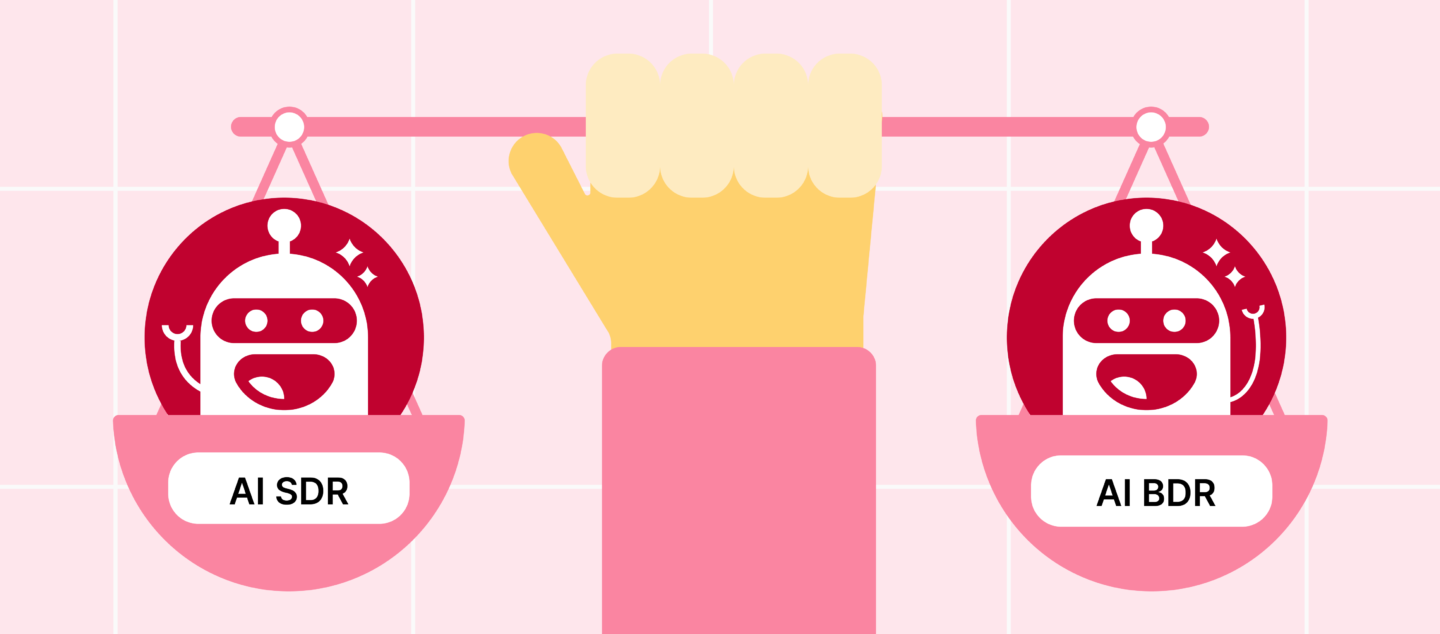
Every sales org hiring in 2026 runs into the same naming fight. One job post says “SDR,” another says “BDR,” and half the hiring managers writing them couldn’t tell you the difference under pressure. Add “AI” in front of either title and the confusion doubles: is an AI SDR a chatbot, a piece of outreach software, or something that actually replaces a hire?
This matters more than a terminology debate. AI SDR vs AI BDR is really a question about where your sales funnel breaks today, and which kind of AI agent fixes that specific break. Get the framing wrong and you buy a tool built for outbound cold-calling volume when your actual problem is a five-hour response time on inbound demo requests.
The human-role split is where the acronyms come from, and it still shapes how the AI versions behave today. The harder question underneath both is whether you actually need one AI agent for this or two.
What is an AI SDR?
An AI SDR is a software agent that handles the sales development representative’s job: qualifying leads, answering initial questions, and booking meetings, without a human doing that work manually. Most AI SDRs today are built for inbound motion, responding to a form fill, a chat message, or a demo request within seconds instead of hours.
The mechanism is what separates a real AI SDR agent from a scripted chatbot. A chatbot follows a decision tree. An AI SDR agent runs on natural language processing instead, reading context (what page the visitor is on, what they typed, what their company looks like), asking clarifying questions, and applying lead qualification logic before it ever loops in a human rep.
Dashly’s own AI SDR platform is built around that inbound-first mechanic: the agent picks up the conversation the moment a visitor engages, qualifies against the criteria a team sets, and routes only sales-ready conversations to a human.
What is an AI BDR?
An AI BDR is a software agent for the business development representative’s job: finding net-new accounts, researching them, and starting outbound conversations at a volume no human team could sustain manually. Where an AI SDR reacts to inbound interest, an AI BDR initiates contact that didn’t exist yet.
In practice, an AI BDR agent pulls firmographic and intent data, drafts personalized outbound sequences across email and LinkedIn, and adjusts messaging based on reply patterns, the relationship building and social selling mechanics of a human BDR, applied at a volume no rep can sustain manually. Vendors like Artisan and AiSDR built entire product lines around this exact mechanic, positioning their agents as a full-time outbound hire replaced by software.
That’s a real use case. It’s also a different problem than the one most inbound-heavy B2B SaaS teams are actually trying to solve, which is why the distinction below matters before you buy either one.
SDR vs BDR: the original human roles
An SDR (sales development representative) qualifies inbound interest, while a BDR (business development representative) generates outbound interest from scratch. That’s the short answer to what is a BDR versus an SDR: both roles sit before an account executive in the funnel, but they work opposite ends of it: one responds to demand, the other creates it.
The split exists because the two skill sets rarely overlap well in one person:
Qualifying an inbound lead well means fast, structured discovery on a conversation someone else started.
Prospecting cold accounts well means research, persistence, and tolerance for a much higher rejection rate.
Both the SDR role and the BDR role typically carry a quota, whether that’s qualified meetings booked from inbound or net-new conversations started from outbound, and growth-stage sales orgs split the roles once volume on either side justifies a dedicated hire.
Smaller teams, and increasingly teams automating either function with AI, often collapse the two back into one function. That collapse is exactly what makes “AI SDR vs AI BDR” a live question instead of a settled one.
Inbound vs outbound focus
SDR work is reactive by design: a visitor requests a demo, fills a form, or opens a chat, and the SDR responds. BDR work is proactive: the rep builds a target list and starts the conversation with no prior signal from the account. Neither is harder, but the two demand different tooling, different qualification criteria, and different definitions of a “good” lead. Strengthening inbound lead generation shifts more of the funnel onto the reactive side, which is exactly why it changes the SDR-to-BDR ratio a team actually needs.
Where AE fits in
The account executive (AE) sits downstream of both roles. An SDR or a BDR qualifies and books; the AE runs the rest of the sales process, from first call to close. In the SDR-vs-BDR-vs-AE framing, the AE is the constant: whichever role feeds it, inbound or outbound, the AE’s job doesn’t change. That’s also true once AI takes over the SDR or BDR seat: the handoff to a human AE stays intact, only the qualification step ahead of it gets faster.
AI SDR vs AI BDR: side-by-side comparison
An AI SDR and an AI BDR differ in trigger, channel, and qualification logic, not in underlying technology. Both are AI-powered agents running on similar language-model infrastructure. What changes is what starts the conversation, where it happens, and what “qualified” means once it does.
Vendor pages sometimes add a third label to this mix: AI sales agent, used as an umbrella term that covers both inbound and outbound variants, and occasionally a full-cycle agent that also handles parts of the AE’s job. Treat that term as the category, not a third distinct role with its own separate mechanic.
| Criteria | AI SDR | AI BDR |
|---|---|---|
| Trigger | Inbound signal (form, chat, demo request) | Target account list, no prior signal |
| Primary channel | Live chat, website, email reply | Cold email, LinkedIn outreach |
| Qualification logic | Fit + intent against a live conversation | Firmographic fit before any conversation exists |
| Response time expectation | Seconds to minutes | Not time-sensitive; volume-driven |
| Success metric | Speed-to-lead, qualified meetings booked from inbound | Reply rate, meetings booked from cold outreach |
Response time and channel coverage
An AI SDR is judged almost entirely on speed, responding to inbound signal in real time instead of on a rep’s schedule. A visitor who asks a pricing question in live chat and waits ten minutes for a reply has usually already opened a competitor’s tab. An AI BDR has no equivalent clock. Its performance shows up over days and weeks, in reply rates and meetings booked, not in how fast the first message goes out.
Qualification logic and lead scoring
An AI SDR qualifies against a live signal: what the visitor asked, what page triggered the chat, what they said when prompted. An AI BDR qualifies before any of that exists, scoring accounts against an ideal customer profile using firmographics, technographics, or intent data purchased or scraped ahead of time. The first is a conversation problem. The second is a data and targeting problem.
Setup complexity and cost
AI BDR platforms typically need more setup work upfront:
- Data source integrations for firmographic and intent signals
- ICP definition and account scoring rules
- Sequence and cadence design across channels
- Deliverability infrastructure for cold email at volume
- A clean sync with existing CRM systems so account and contact data doesn’t fork into two places
An AI SDR built for an existing inbound channel has a shorter runway to first value, since it’s plugging into traffic and conversations that already exist rather than generating new contact points from zero.
Can one AI agent do both SDR and BDR work?
Yes, in principle, because the constraint that forced human teams to split the role, one person can’t be great at both reactive qualification and cold prospecting, doesn’t apply the same way to software. An AI agent doesn’t get worse at outbound because it also handles inbound; it just needs separate logic for each trigger type.
In practice, most teams still get more value from an agent that’s deeply good at one motion than a generalist that’s mediocre at both. The unification argument works best when the underlying qualification engine is shared even if the entry points differ, so a lead that comes in cold through outbound and a lead that comes in warm through the website get evaluated against the same fit criteria.
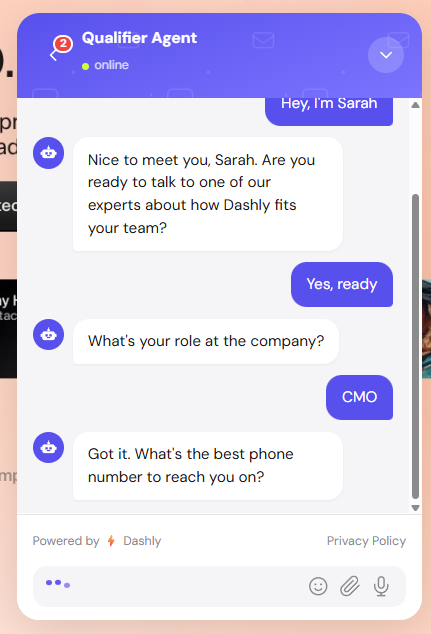
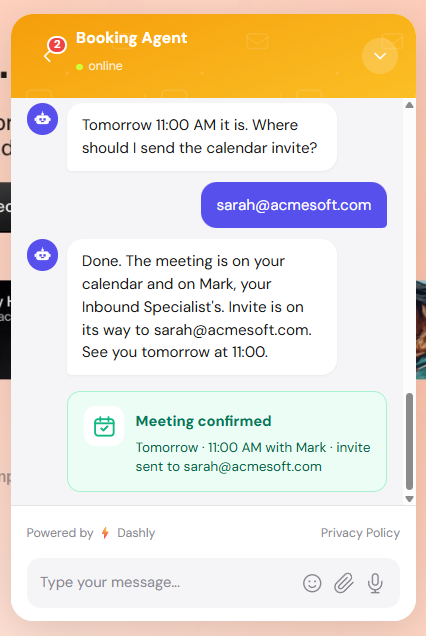
Dashly’s AI qualifier agent is built on that shared-logic principle: qualification criteria live in one place, and the agent applies them consistently whether the conversation started from an inbound chat or was routed in from another channel. The point isn’t collapsing headcount for its own sake; it’s not re-litigating what “qualified” means every time a lead enters through a different door.
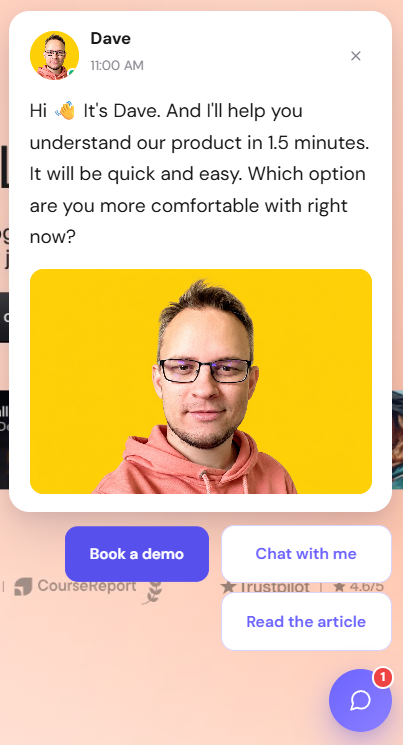
Here’s what the workflow looks like:
Step 1: Engagement
Step 2: Qualification
Step 3: Booking
Which one does your inbound pipeline actually need?
Start with the actual pain points in your pipeline. If your website, product, and content already generate demo requests and chat conversations that sit unanswered for hours, that’s an AI SDR problem: you have demand, and it’s leaking before qualification.
If your pipeline is thin because nobody is reaching out to accounts that haven’t shown any signal yet, that’s an AI BDR problem: you don’t have enough demand to qualify in the first place.
Most B2B SaaS teams have more of the first problem than they think. Traffic and product usage generate more qualifiable signal than sales ever gets to in time, and fixing that shows up as a lift in conversion rate on traffic you already have, which is a different fix than adding outbound volume. That’s the case for treating AI agents for B2B SaaS as a speed-to-lead investment before an outbound-volume one.
Can AI SDR or AI BDR replace human reps?
An AI SDR or AI BDR can absorb most of the repetitive qualification and first-touch work a junior rep does, but it doesn’t remove the need for a human AE to run the actual sales cycle. What it changes is headcount math at the entry level: instead of hiring a second or third SDR to keep pace with growing inbound volume, the AI agent absorbs that volume and the team hires AEs against qualified pipeline instead.
Full replacement is a harder claim than most vendor pages make it sound. Complex enterprise deals, multi-threaded accounts, and edge-case objections still route to a human faster than a fully autonomous agent handles them well today. Treat AI SDR and AI BDR agents as a filter that gets more of the right conversations to your AEs faster, not as a complete substitute for every rep on the team.
Key takeaways
SDR and BDR started as two answers to two different funnel problems: qualifying demand versus creating it. AI SDR and AI BDR inherited that same split, just running on software instead of a headcount plan. The comparison table above holds regardless of which vendor you’re evaluating: trigger, channel, and qualification logic are what actually differ, not the underlying technology. For the operational side of running an AI SDR day to day, the AI SDR rollout playbook covers the sequencing most teams get wrong on the first try.
Pick based on where your pipeline actually breaks today. An inbound-heavy team with slow response times needs an AI SDR before it needs an AI BDR. A team with no inbound signal to qualify needs the opposite. Either way, the qualification logic underneath matters more than the acronym on the product page.
FAQ
An SDR qualifies inbound leads that already showed interest, while a BDR generates outbound interest from accounts that haven’t engaged yet. Both roles feed an account executive, but they work opposite ends of the funnel.
BDR stands for business development representative. The BDR meaning in practice is an outbound-focused role: prospecting new accounts and generating pipeline from contacts with no prior inbound signal.
An AI SDR is one type of AI sales agent, specifically focused on qualifying inbound leads. The broader category of AI sales agent also covers outbound-focused agents (AI BDR) and full-cycle selling agents, so the terms overlap but aren’t identical.
An AI BDR can absorb most of the repetitive research and outbound messaging a BDR does, but complex account strategy and multi-threaded outreach still benefit from human judgment. Most teams use AI BDR agents to increase outbound volume rather than eliminate the role entirely.
SDR and BDR both qualify or generate leads before a deal starts, one from inbound signal, one from outbound prospecting, while the account executive (AE) owns the sales cycle after that qualification happens, from first call through close.
Only if your pipeline has both problems at once: inbound leads going unanswered and too few outbound conversations starting at all. Most teams have more of one problem than the other, so start with whichever gap is costing more qualified pipeline today.
The right AI SDR tool depends on whether you need inbound qualification, outbound prospecting, or both. See the full breakdown in Dashly’s AI SDR tools comparison for a side-by-side look at what each platform actually handles.






![Inbound marketing funnel: Stages, strategy & how to build one [2026]](https://www.dashly.io/blog/wp-content/uploads/2025/03/building-your-inbound-marketing-funnel-a-caring-step-by-step-guide-3-720x405.jpg)