Lead nurturing workflow: a step-by-step framework that converts in 2026
 15 minutes
 15.07.2026
Most B2B teams don’t have a lead problem. They have a follow-up problem. A visitor downloads a guide, books a demo, or asks a question in chat, and then the trail goes cold: one automated email, maybe two, then silence until a rep remembers to check the CRM.
That gap is where deals die quietly. According to The Starr Conspiracy’s 2025 B2B marketing automation benchmark report, citing Salesforce’s 2024 State of Sales research, B2B companies running advanced automation workflows cut their average sales cycle by 32% compared to teams relying on manual follow-up.
A lead nurturing workflow is what closes that gap: the operational sequence, triggers, segments, content, cadence, and exit rules, that moves a lead from “submitted a form” to “ready to talk to sales” without a rep babysitting every step. That’s different from a lead nurturing strategy, which sets the overall approach rather than the day-to-day mechanics.
This guide breaks that sequence into nine concrete steps, shows what a workflow actually looks like across email, chat, and multichannel setups, and gives the benchmarks to check whether yours is working.
What is a lead nurturing workflow?
A lead nurturing workflow is the automated sequence of triggers, segments, content, and follow-up actions that carries a lead from first contact toward a sales-ready state. It differs from lead nurturing as a discipline, which covers strategy and messaging, by being the operational machine: what fires, for whom, on what schedule, and when it stops.
Most teams already have a philosophy around lead nurturing long before they’ve built the workflow that actually executes it. That’s the gap this guide closes.
A campaign is a different thing entirely: one send, or one themed series, aimed at a moment, a launch, an event, a seasonal push. A workflow runs continuously, triggered by behavior, and keeps running as long as new leads keep entering it.
Three things separate a workflow that works from one that stalls.
- A trigger precise enough to catch the right moment
- Segmentation specific enough to avoid sending every lead the same three emails in the same order
- An exit rule that removes leads once they convert, unsubscribe, or go cold
Why lead nurturing workflows matter in 2026
Lead nurturing workflows matter because most B2B pipelines lose potential customers to inaction, not disinterest. Whether the leads come from inbound marketing, outbound prospecting, or a mix of both, companies running mature nurturing automation added 43% more qualified leads in their first year of adoption and cut average sales cycle length by 32%, turning nurturing from a marketing nice-to-have into a metric a CRO tracks directly.
Those two numbers come from the same place: The Starr Conspiracy’s 2025 report, which cites HubSpot’s 2024 State of Marketing data for the lead increase and Salesforce’s 2024 State of Sales data for the sales-cycle drop.
The bigger problem sits upstream of both numbers.
An analysis of B2B lead conversion data found that businesses fail to convert 79% of the leads that enter their funnel (Demandsage, 2025). Most of that loss isn’t bad-fit leads. It’s leads that never got a second touch, got the wrong touch, or got a touch so generic they tuned it out.
Part of that is timing. The same analysis cites Forrester research showing only about 5% of leads are sales-ready the moment they convert. The other 95% need a structured nurturing workflow before a rep should spend time calling them (Demandsage’s 2025 lead-generation research).
That’s the strategic case for building one.
👉 For the fuller B2B-specific playbook, from segmentation frameworks to email sequencing, see our B2B lead nurturing playbook. This guide stays focused on the workflow itself: the machine, not the strategy behind it.
The anatomy of a lead nurturing workflow
A lead nurturing workflow has five moving parts:
- Trigger that starts it,
- Segment that decides who enters,
- Cadence that paces the touches,
- Set of channels that carry them,
- Exit rule that ends it.
Miss the exit rule and the workflow keeps nurturing customers, unsubscribes, and closed deals indefinitely.
The trigger is usually behavioral: a landing-page form fill, a pricing-page visit, a chat conversation that didn’t convert, a free-trial signup. The tighter the trigger, the more relevant the first message can be.
Segmentation is where most workflows fall apart in practice, not in theory. Everyone agrees leads should be segmented by persona, company size, or funnel stage. Few teams have the underlying data clean enough to do it consistently.
A lead nurturing workflow is only as good as the data feeding its segments. A workflow with perfect branching logic and stale, scattered lead data will still send the wrong message to the right person.
Most workflow guides skip the exit rule entirely. Zendesk’s own lead nurturing guide walks through five nurturing strategies and six best practices without ever specifying when a lead should stop receiving nurture messages (Zendesk). That gap is why leads who already converted, or already said no, keep showing up in nurture sequences months later.
That handoff point is exactly where a marketing funnel becomes a sales pipeline, if the workflow is built to recognize it. In practice, almost nobody owns that recognition: marketing builds the workflow, sales owns the pipeline, and the moment a lead crosses from one to the other falls into whichever system happens to sync last.
The workflow’s job is to make that recognition automatic, not to leave it as an ad hoc judgment call a rep makes months after the lead already cooled off.
Map each stage of the workflow to a stage in your sales funnel, not a separate track the sales team never sees. A workflow that runs in a marketing silo produces leads sales doesn’t trust.
How to build a lead nurturing workflow in 9 steps
Building a lead nurturing workflow means working through nine sequential decisions: sales cycle mapping, persona definition, goal setting, content mapping, message drafting, workflow logic, channel selection, testing, and launch. Skipping a step doesn’t save time. It just moves the failure downstream to a point where it’s harder to diagnose.
1. Map your sales cycle and buyer journey
Before building anything, chart how a typical deal actually moves through your sales process, from first touch to close, including every point where deals stall. This becomes the backbone the workflow’s triggers attach to, so each nurture touch matches a real moment in the buyer journey instead of an arbitrary day-3, day-7, day-14 schedule.
2. Define personas and segments
Buyer personas only matter here if they change what you’d send. If your enterprise and SMB leads get the same three emails in the same order, you don’t have segments. You have one workflow pretending to be three.
Getting that segmentation right depends on a lead profile that actually holds the data: one record per lead with firmographic, behavioral, and channel history, not a CRM field nobody’s touched since the form fill.
3. Set measurable goals per workflow
Decide what “working” means before launch: a target share of qualified leads advancing to a sales conversation, a target reply rate, a target time-to-MQL. Without a number, “the workflow is working” is just a feeling.
4. Map content to each stage
Every stage of the journey needs relevant content that answers the pain point a lead actually has at that moment, not whatever happens to be sitting in the CMS. A pricing objection three weeks in needs a different asset than a general awareness question on day one.
5. Write nurture messages that earn a reply
Keep each message short and single-purpose, sent from a named person rather than a “Team” alias. One CTA per message beats three options competing for the same click. The welcome email sets the quality bar the rest of the sequence has to match, since it’s the first real test of whether the workflow can build trust before it asks for anything.
6. Build the workflow logic: branching, cadence, exit rules
This is where segmentation stops being a spreadsheet exercise and becomes if/then logic. If a lead opens three emails without clicking, branch to a different message. If a lead visits the pricing page, branch straight to a sales-notify step. If a lead unsubscribes or books a meeting, exit immediately.
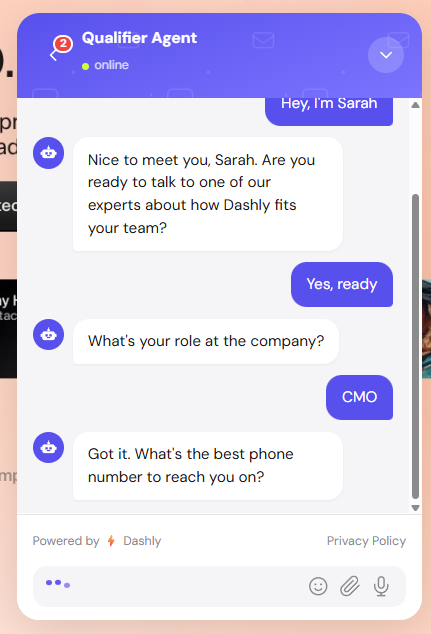
Manually maintaining that branching logic is exactly the kind of repetitive judgment call Dashly’s AI Qualifier Agent is built to take over. It holds the qualifying conversation itself, tags each lead MQL or not, and routes them into the right branch automatically, instead of a marketer re-tagging leads by hand every time a scoring rule changes.
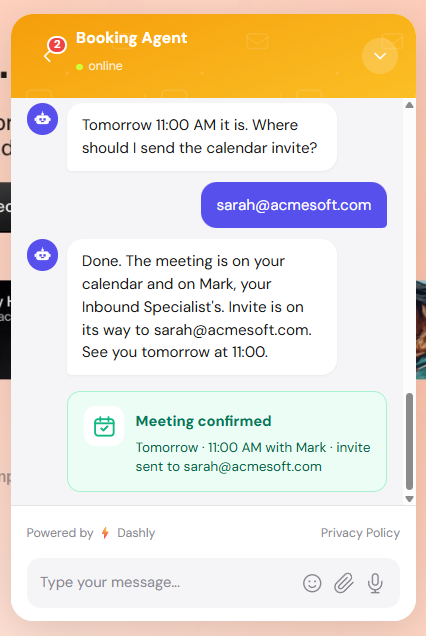
Here’s what the workflow looks like:
Step 1: Engagement
Step 2: Qualification
Step 3: Booking

7. Add multichannel touchpoints
Email-only workflows leave reach on the table for leads who never open email but respond within minutes on chat. Layering in multi-channel lead nurturing, chat, WhatsApp, or Telegram alongside email, catches leads on the channel they actually use.
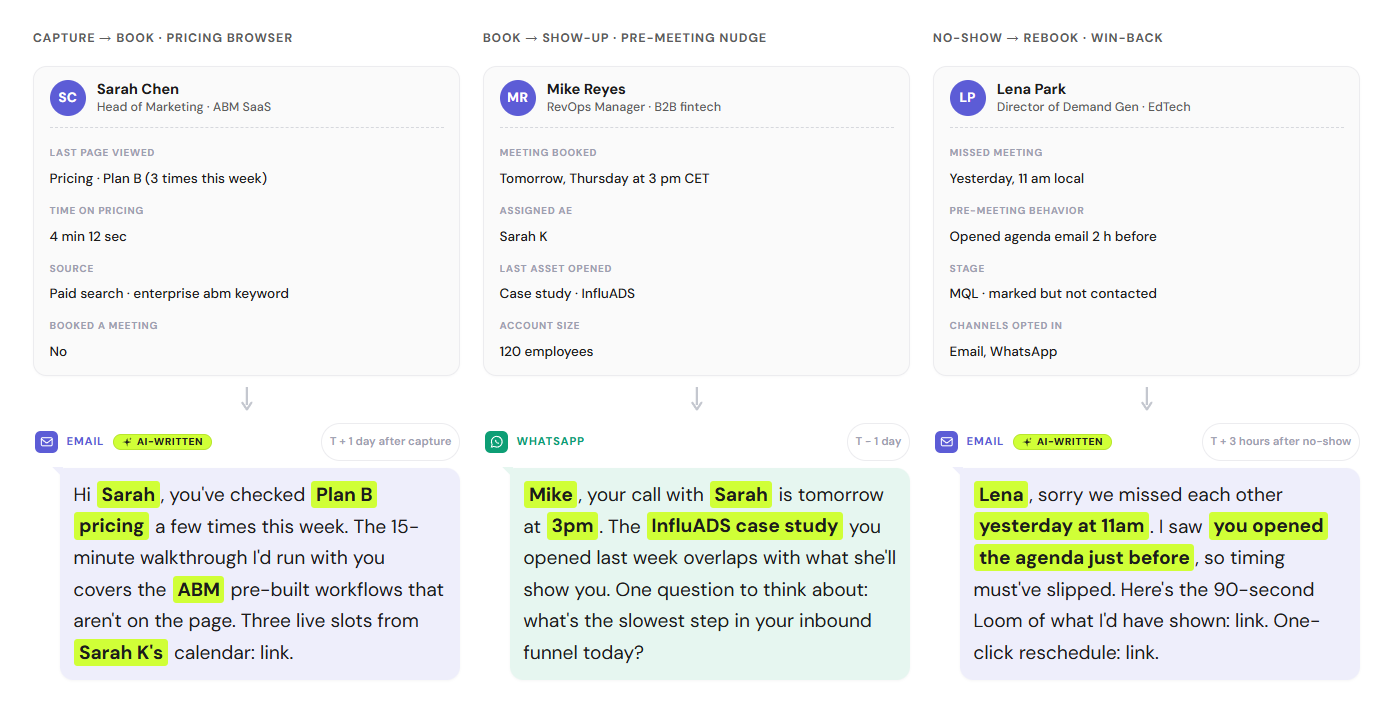
Here’s how nurturing messages can be personalized depending on user behavior:
8. Test the workflow before it goes live
Run yourself, or a small internal group, through the full sequence before real leads see it. Check timing, check that branch logic actually branches, check every link.
9. Launch, measure, and iterate
Ship the workflow, then treat week one and week two as a pilot, not a verdict. Cadence and content decisions made on assumptions need real open, click, and reply data before you trust them.

Lead nurturing workflow examples
Four patterns cover most of what a B2B or B2B2C team needs to build: an email-only sequence, a multichannel sequence, a B2B SaaS trial-to-paid sequence, and an e-commerce cart-recovery sequence.
Email-only nurture sequence
A simple lead nurturing email workflow: a welcome email on day 0, a case-study email on day 3, an objection-handling email on day 7, and a direct meeting-request email on day 12, exiting the moment a meeting is booked or the lead replies “not now.”
Multichannel example: email, chat, and WhatsApp
A lead who fills out a form gets an immediate email. If they return to the site within 48 hours, the next touch shifts to a chat message instead of waiting for the next scheduled send.
Orchestrating that channel switch manually means a marketer watching site activity in real time, which stops scaling past a handful of leads. Dashly’s nurturing scenarios bring a lead back with a follow-up on email or WhatsApp that asks them to finish the qualifying question or grab a meeting slot, instead of a marketer manually watching site activity and guessing when to nudge someone.
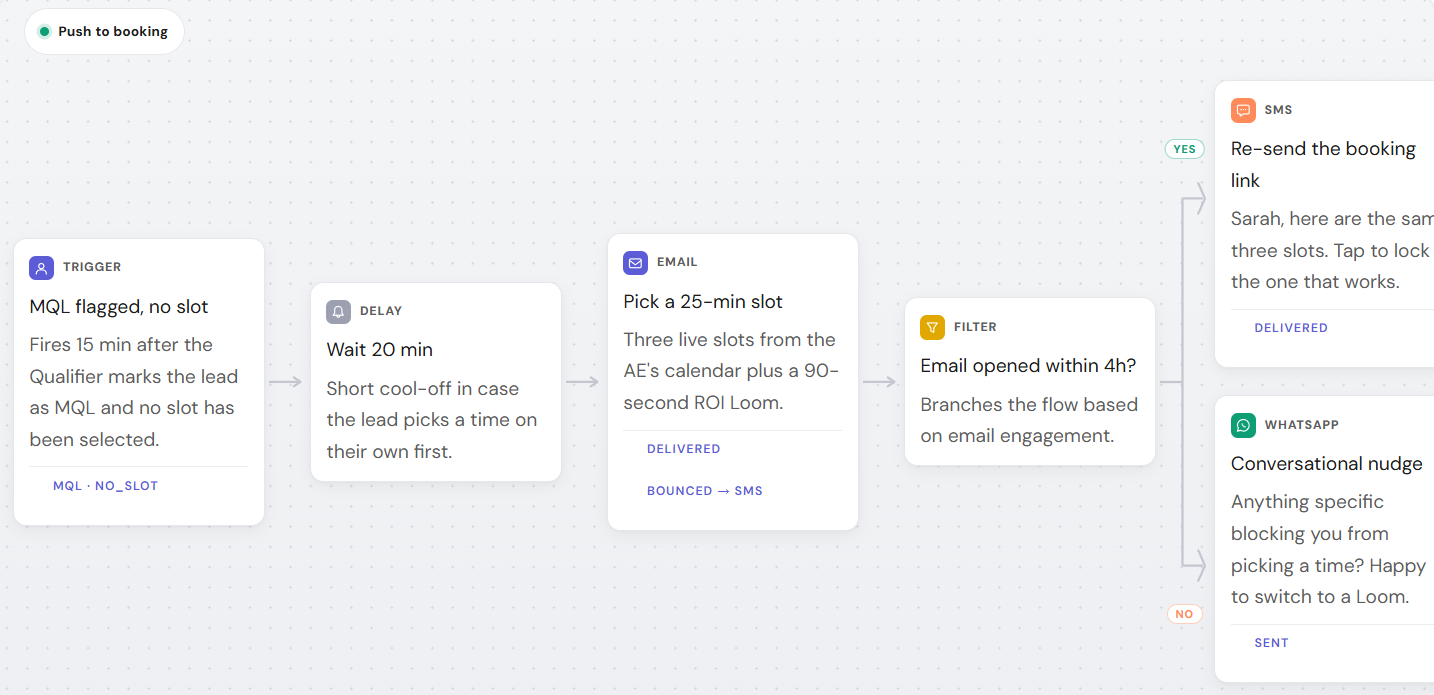
Here’s an example of an AI flow for booking a meeting:
B2B SaaS example: trial-to-paid workflow
Trial signup triggers a workflow that branches on product usage. Leads who complete onboarding get a feature-adoption sequence. Leads who don’t log in within three days get a re-engagement sequence. Leads who hit a usage-based upgrade trigger get routed to sales instead of marketing.
E-commerce example: abandoned cart re-engagement
Abandoned-cart nurturing follows the same anatomy as any other workflow: a trigger (cart left for one hour), a segment (cart value, first-time versus repeat buyer), a cadence (reminder at one hour, incentive at 24 hours, final notice at 72 hours), and an exit (purchase or unsubscribe).
Lead nurturing workflow tools and platforms
Most teams don’t need to settle a philosophy before choosing a workflow tool. The platform, whether that’s a full automation software suite or a lighter CRM software add-on, mostly decides how much of the logic above gets automated versus built by hand.
HubSpot
HubSpot workflows, the platform’s native workflow builder, cover most of the branching logic from step 6 without custom code. Setting up a lead nurturing workflow in HubSpot mainly means mapping the enrollment trigger and branch conditions correctly on the first try, then testing before scaling audience size.
Marketo and other marketing automation platforms
Marketo and comparable marketing automation platforms handle nurturing workflows at higher lead volumes and with more granular lead scoring, at the cost of more setup complexity than HubSpot’s builder.
Automation builders like n8n for custom logic
Teams that need branching logic their marketing platform doesn’t natively support often build it in an automation tool like n8n, wiring CRM triggers, scoring APIs, and messaging channels into one custom workflow instead of forcing the logic into a platform’s native builder.
CRM-native workflows
A CRM lead nurturing workflow keeps the trigger, segment, and exit logic inside the same system that owns the lead record, which avoids the sync lag that shows up when nurturing runs in a separate marketing tool.
AI-native platforms
Where the tools above automate the mechanics, AI-native tools are starting to automate the judgment calls, like scoring, routing, and channel selection, that used to require a marketer’s manual rule. See our roundup of the best AI lead nurturing tools for a side-by-side comparison.
How to measure and optimize a lead nurturing workflow
A lead nurturing workflow is working if its click-through rate beats the B2B baseline, its unsubscribe rate stays low, and its conversion rate from enrolled lead to sales conversation keeps climbing, not just its open rate.
Start with the email baseline. B2B email marketing averages a 39.48% open rate and a 2.21% click-through rate (HubSpot). A nurture sequence underperforming that baseline usually has a targeting problem, not a copy problem: the trigger is too broad, or the segment is wrong.
Beyond email metrics, track the number that actually matters to a CRO: the percentage of workflow-enrolled leads that reach a sales conversation, and how that percentage moves as cadence and content change.
A workflow that opens well but converts to meetings at half the rate of your best-performing segment usually has a content-mapping problem from step 4, not a deliverability problem.
Attribution gets messy the moment a lead touches more than one channel, which is most leads in a workflow with more than two steps. The simplest fix that scales: tag the workflow and step at enrollment, not just the final converting touch, so a lead that opened three emails and then converted from a chat message doesn’t get credited entirely to chat.
Common lead nurturing workflow mistakes to avoid
The mistakes that break lead nurturing workflows are structural, not creative. A bad subject line costs an open. A missing exit rule, over-emailing, or no disqualification criteria costs the whole workflow’s credibility with leads and with sales.
- No exit or disqualification rule: leads keep receiving nurture messages after they convert, unsubscribe, or clearly disqualify themselves, the fastest way to burn trust with someone who already said no
- Uncapped cadence: sending every scheduled email regardless of engagement, instead of slowing down or pausing for leads who haven’t opened the last three
- No sales handoff criteria: marketing owns the workflow end to end with no defined moment where a lead becomes the sales team’s responsibility or gets a clear next step, so hot leads sit in the workflow past their buying window
- Single-channel tunnel vision: following lead nurturing best practices built entirely around email, even for leads who’ve shown they respond faster on chat
- No re-engagement branch: cold leads get removed instead of routed into a lower-frequency track that keeps the door open without the original cadence
Conclusion
A lead nurturing workflow is the operational layer underneath lead nurturing as a strategy: the specific triggers, segments, cadence, and exit rules that decide whether a lead gets the right message at the right moment or gets lost in a generic drip.
Building one well means working through the five anatomical parts, trigger, segment, cadence, channel, exit, and the nine build steps in order, then measuring against real benchmarks instead of assuming it’s working because emails are going out.
The workflows that outperform in 2026 share two traits the older playbooks above rarely covered. They run across more than one channel, and they use AI to handle the scoring and routing decisions that used to require a marketer checking a spreadsheet by hand.
FAQ
A lead nurturing workflow is the automated sequence of triggers, segments, content, and follow-up actions that moves a lead from first contact to a sales-ready state. It’s the operational layer underneath the broader lead nurturing strategy, deciding exactly what happens, for whom, and when it stops.
A strategy defines the overall approach: which channels to use, which personas to target, and what content themes to build. A workflow is the specific automated sequence that executes that strategy day to day. See our guide on lead nurturing strategy for the strategic layer.
Most B2B lead nurturing email workflows work best capped around 6 to 8 emails per sequence, spaced days apart rather than daily, with an exit rule that removes converted or unengaged leads before the sequence runs its full length.
A common example pairs a welcome email on day 0 with a case-study email on day 3 and a direct meeting-request email around day 10 to 12, exiting the moment the lead books a meeting. See our lead nurturing campaign breakdown for channel-mixed examples.
At minimum, a CRM or marketing automation platform with workflow logic, such as HubSpot or Marketo, plus a way to segment leads accurately. Compare options in our lead nurturing software roundup or browse the lead nurturing tools category.
Automating B2B lead nurturing means moving from manual list-based sends to trigger-based workflows with branching logic, typically layering in lead scoring so high-intent leads get routed to sales faster than low-intent leads in the same sequence. Our B2B lead nurturing playbook covers the fuller approach.
Stop nurturing a lead the moment they convert, explicitly opt out, or hit a defined inactivity threshold, typically 60 to 90 days with no opens or clicks. Leads past that threshold should move to a low-frequency re-engagement track instead of the standard sequence.




![Lead generation guide for B2B SaaS: Strategies, tools, and real examples [2026]](https://www.dashly.io/blog/wp-content/uploads/2022/09/Lead-Generation-08-720x317.png)