How to build a sales funnel: Step-by-step guide for B2B teams in 2026
 15 minutes
 14.07.2026
Most sales teams build their funnel backwards. They start with stages, then wonder why leads stagnate between them for weeks. The real problem is the absence of two things: clear stage-transition criteria and messaging that matches where the buyer actually is in their decision.
This guide gives you a 7-step framework to create a sales funnel that converts, from ICP definition to conversion tracking. You’ll walk away knowing how to map your buyer journey, set up lead generation at each stage, qualify inbound leads at scale, and diagnose where your pipeline leaks before it becomes a revenue problem. We’re writing for B2B SaaS and services teams.
What is a sales funnel and why it matters
A sales funnel is a structured framework that maps how potential buyers move from first awareness of your product to a purchase decision. It gives your team a shared language for where every lead stands, makes conversion gaps visible, and tells you exactly where to invest in messaging or automation.
Without a defined funnel, you’re running sales on instinct. You can’t diagnose why revenue dropped last quarter if you don’t know which stage is leaking. According to Salesforce’s 2024 State of Sales report, high-performing sales teams are significantly more likely to follow a documented sales process than teams that consistently miss quota.
The funnel isn’t a rigid path. Buyers jump stages, re-enter from referrals, and sometimes circle back months after going cold. What the funnel gives you is a way to organize your response to each of those scenarios.
👉 For a full definition, see our guide to the sales funnel.
What are the 4 stages of a sales funnel?
Most B2B funnels follow a four-stage model: Awareness, Interest, Decision, and Action. At the awareness stage, buyers first recognize that a problem exists and start searching for solutions. Each subsequent stage maps to a different buyer question and requires a different response from your team. Understanding this framework is the foundation of every step that follows.
| Stage | Buyer question | Your job |
|---|---|---|
| Awareness | “I have a problem. What might solve it?” | Create visibility through SEO, ads, and referrals |
| Interest | “How does this category work?” | Educate with case studies, demos, and comparisons |
| Decision | “Is this vendor right for us?” | Build confidence with ROI proof and objection handling |
| Action | “What do I need to do to start?” | Remove friction from contracts and onboarding |
For complex B2B deals, many teams add a fifth stage between Decision and Action: Evaluation, where legal, IT, or procurement review the vendor. If your average deal cycle exceeds 60 days, map that stage explicitly or you’ll lose pipeline visibility during the approval process.
👉 For a detailed breakdown of each stage and the metrics that go with it, read our guide on sales funnel stages.
How to build a sales funnel in 7 steps
To build a sales funnel, define your ICP, map stage-specific content to each buyer stage, set up lead capture, qualify inbound leads, build nurture sequences, define stage-transition criteria, and track conversion rate per stage. The 7 steps below follow this sequence: each one builds on the last. Start with Step 1 before touching tools or automation.
Step 1: Define your ICP and map their buyer journey
Your ideal customer profile (ICP) and the buyer personas that flow from it are the foundation. Without them, you’ll build a funnel that attracts everyone and converts few. Define your ICP across three dimensions: firmographics (company size, industry, growth stage), technographics (tools they already use), and psychographics (the pain points and fears that drive their search).
Once you have your ICP defined, interview 5-10 recent customers. Ask: “What triggered you to start looking?” and “What almost stopped you from buying?” Their answers reveal the exact moments your funnel must catch, in their own words, not yours.
Map what your ICP does at each stage: where they search, what they read, who they trust. This customer journey map becomes your content and channel strategy in Steps 2 and 3.
Step 2: Map content and messaging to each stage
Most teams publish top-of-funnel blog posts and a bottom-of-funnel demo page, then wonder why the middle of their funnel is empty. Stage-specific content fills the gap between “discovered you” and “ready to buy.” Without it, you’re generating awareness you can’t convert.
For each stage, define three things: the format that works best (blog post, case study, video, email), the question the content answers, and the CTA that matches the stage. The last point matters more than most teams realize. A decision-stage lead who clicks “Read more blog posts” is being sent backwards. Give them a comparison, an ROI calculator, or a direct calendar link instead.
- Top of funnel (Awareness): SEO blog posts, paid social content, podcast appearances. Answers “what is this problem?”
- Middle of funnel (Interest): Case studies, product explainer videos, comparison guides. Answers “how do others solve this?”
- Bottom of funnel (Decision): ROI calculators, detailed demos, security documentation, proposals. Answers “why you specifically?”
Step 3: Build your lead capture mechanism
Every funnel needs a capture point where anonymous visitors become known contacts and your lead generation starts working at scale. The most common mechanism is a landing page with a lead magnet gated behind a form. A high-converting capture page has one job: make a specific promise and ask for one action.
Remove navigation, minimize distractions, and align the headline precisely to the ad or content that sent traffic there. A page that tries to serve multiple audiences converts poorly across all of them.
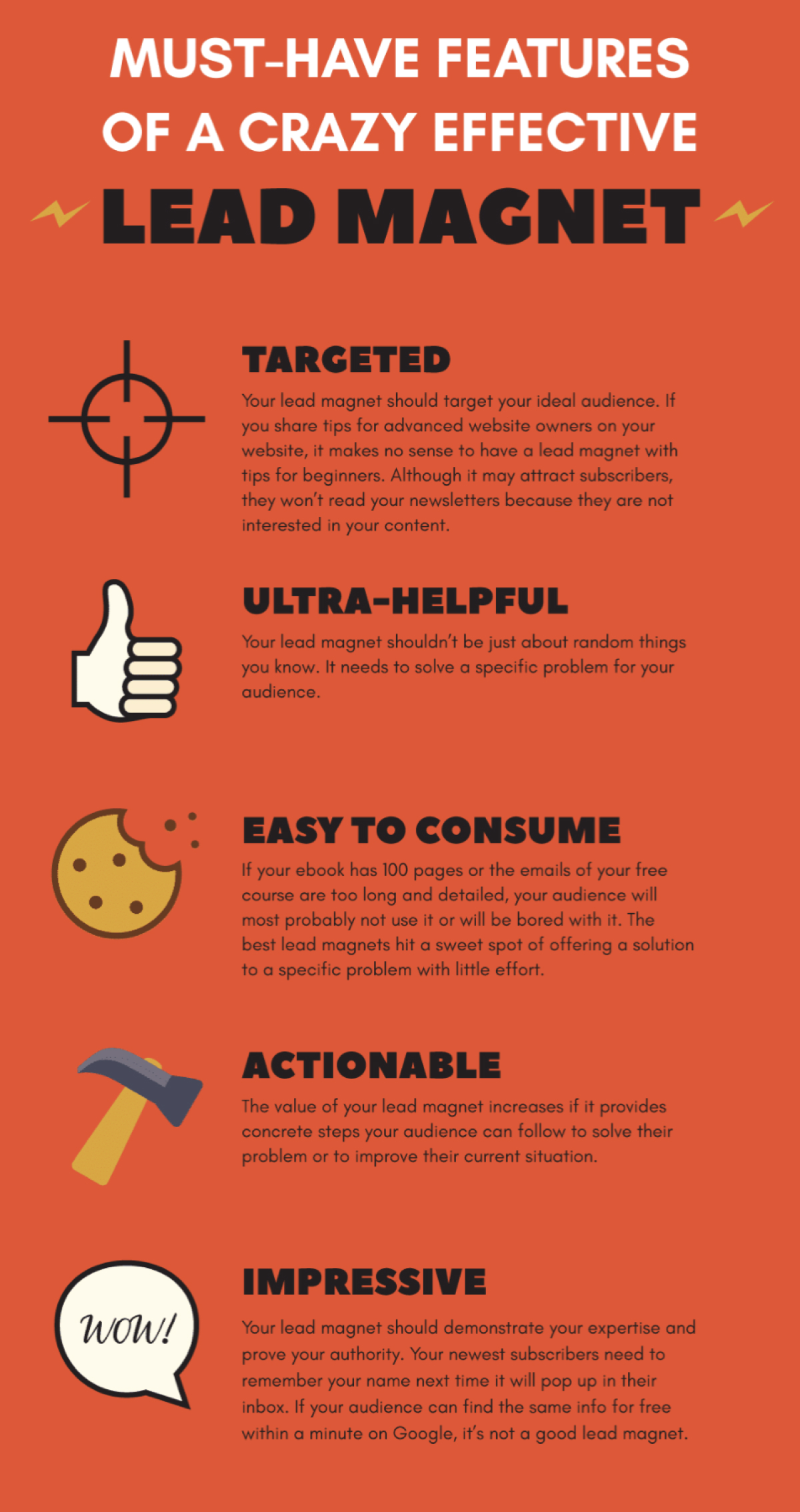
B2B lead magnets that consistently earn form fills: an ROI calculator, a benchmark report, a free audit of a specific process, or an email course that addresses a question your ICP asks before every purchase decision. Pick one that solves a genuine pre-purchase problem, not one that’s easy for you to produce.
Here are few tips on making an actually useful lead magnet:
Step 4: Set up lead qualification
Qualification is where most B2B funnels break. Without a clear filter, every lead that fills a form lands in your CRM as equal, and your sales team wastes capacity on accounts that will never close.
Lead qualification is the process of determining whether a prospect matches your ideal customer profile well enough to receive direct sales attention. A qualified lead meets your predefined criteria for company size, role, budget, and urgency. An unqualified lead enters a longer-term nurture track, not a sales rep’s queue.
Define your qualification criteria before launch. Common B2B qualification criteria:
- Company size above your ICP threshold
- Seniority level (director or above for most mid-market deals)
- A relevant technology stack in use
- A budget signal in the conversation
- An urgency indicator (active evaluation, renewal, or team growth)
A lead matching 4 of 5 criteria moves forward. A lead matching 1 of 5 goes to nurture.
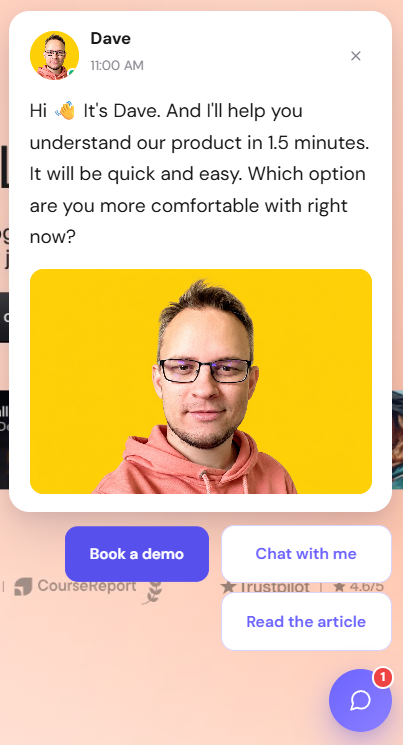
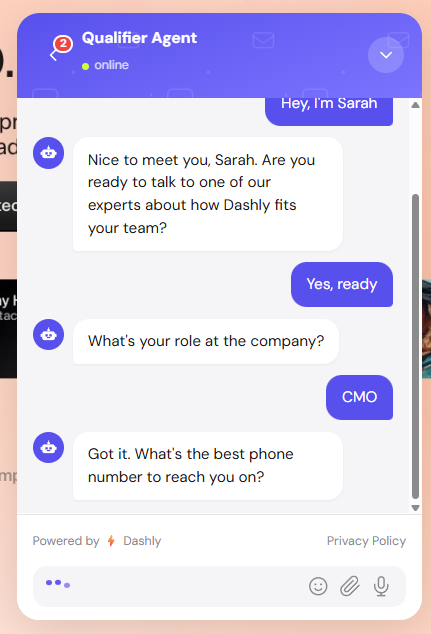
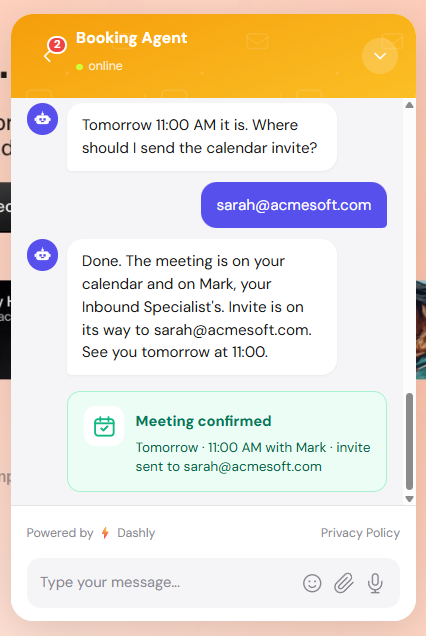
Qualifying leads manually takes a significant portion of the selling day, time that compounds when your team is processing dozens of inbound leads per week. Dashly’s AI qualifier agent engages every inbound lead the moment they fill a form, asks your qualification questions in a natural conversation, and scores the lead against your ICP criteria. Your team only opens a conversation when there’s a genuine fit.
Step 1: Engagement
Step 2: Qualification
Step 3: Booking
Step 5: Build nurture sequences for each stage
Nurture sequences are the engine that moves leads through your funnel without requiring a sales rep at every touchpoint. Build a separate sequence for each stage, not a single drip that treats a cold prospect the same as someone who watched your demo and didn’t reply.
At the Interest stage: 4-5 emails over 10-14 days, sharing case studies, product explainers, and comparison content. The goal is to build trust through consistent evidence, so the lead self-qualifies upward into the Decision stage.
At the Decision stage: 3-4 emails focused on objection handling, ROI evidence, and social proof. Include a direct calendar link for the assigned rep. Pair the sequence with direct outreach from the rep: a personalized message at this stage lifts response rates well above automation alone. A lead visiting your pricing page twice in one week is a signal worth acting on immediately, not in three days when your drip fires.
Step 6: Define stage transition criteria
Stage transition criteria are the exact conditions that must be true before a lead advances from one sales funnel stage to the next. Without them, reps use gut feel, stages fill with stale contacts, and pipeline forecasts become unreliable. This is the step most guides skip, and the single most reliable fix for a funnel that stagnates without obvious cause.
Write the exact conditions that trigger a stage change. For example:
- Interest to Decision: lead attended a demo AND visited pricing at least once
- Decision to Action: lead replied to a rep AND requested a contract or proposal
- Action to Closed-Won: contract signed, first payment received
These criteria become the rules your CRM enforces automatically. Your CRM funnel view then reflects real buyer behavior rather than rep opinion, which makes pipeline forecasting reliable. This single change to your sales funnel process improves forecast accuracy faster than almost anything else you can implement.
Step 7: Track and measure funnel performance
A funnel you can’t measure is a guess. Effective sales funnel management starts with tracking three metrics at minimum before you consider the build complete: conversion rate per stage, funnel velocity, and lead volume by source.
Conversion rate per stage is the core diagnostic. If 60% of leads enter Interest but only 12% reach Decision, you have a mid-funnel problem, not a top-of-funnel one. Funnel velocity shows whether leads are moving or stagnating by stage. Lead volume by source connects your acquisition channels to actual revenue so you know where to invest next quarter.
👉 For a complete breakdown of the KPIs to track and benchmark ranges for each, read our guide on sales funnel metrics.
How to build a B2B sales funnel (what’s different)
A B2B sales funnel uses the same four-stage model, but the mechanics at each stage are substantially different from a consumer purchase. When a deal involves a six-figure contract, multiple stakeholders, and a procurement process, the tactics designed for simpler buying decisions stop working reliably.
Longer buying cycles. Mid-market B2B deals typically run 3-6 months from first contact to close. Enterprise accounts often extend to 9-12 months. Your nurture sequences need to match that timeline, not a 2-week drip built for software with a free trial and instant checkout.
Multiple stakeholders. B2B purchasing decisions routinely involve separate reviewers across revenue, technical, and legal teams. Your champion fills the form. The economic buyer, IT reviewer, and procurement team often never speak to you directly. Build content that speaks to each stakeholder’s specific concern, not just the person who initiated the search.
Formal evaluation stage. B2B funnels almost always include a vendor review between Decision and purchase: security assessment, proof of concept, or legal review of the contract. Map this stage explicitly. Deals that look “almost closed” stall here for weeks if you haven’t prebuilt the materials procurement needs to move forward.
👉 For a detailed breakdown of the tactics specific to B2B buyer behavior, read our guide on the B2B sales funnel.
How to build a sales funnel for free
Funnel building costs almost nothing at the start. The free-tier stack below covers the core mechanics for most early-stage B2B teams: lead capture, contact management, email sequences, and basic conversion tracking.
- HubSpot CRM (free tier): contact management, deal stages, and email sequences up to 2,000 sends per month
- Dashly (free plan): live chat and lead capture on your website, with conversation-based qualification
- Google Analytics 4: funnel tracking and conversion monitoring across your site at no cost
- Mailchimp (free tier): up to 500 contacts, email campaigns with basic automation
The free stack works until two things happen: you outgrow contact limits, or you need automation rules that require paid triggers. Most teams hit the ceiling somewhere around $5k-20k MRR and need to upgrade at least one tool. At that point the decision is usually between a dedicated CRM with automation or a combined platform that handles capture, qualification, and nurture in one place.
What are the most common sales funnel mistakes?
The most common sales funnel mistakes are missing stage-transition criteria, treating all leads equally, measuring only final close rate, and building content for one stage only. All four are fixable once you identify which one is driving your drop-off.
No transition criteria. Stages become meaningless when reps move leads based on gut feel. Pipeline reports reflect opinion, not buyer behavior. Fix: write the exact conditions that trigger a stage move and enforce them in the CRM, not just in a shared document no one reads after week one.
Treating all leads equally. Sending the same email sequence to a potential customer who watched your demo and one who downloaded a generic guide wastes both. Segment nurture by lead behavior, not just by entry point into the funnel.
Measuring only final close rate. If your close rate drops from 18% to 11%, you don’t know where the problem is without stage-level conversion data. Measure conversion at every stage. The stage where conversion dropped is where you fix things first.
Building only top-of-funnel content. SEO blog posts drive traffic. They don’t close deals. If your content mix is 90% awareness and 10% decision-stage, your funnel consistently produces leads that go cold before they buy. Balance content investment across all four stages of your sales funnel process.
How to measure your sales funnel performance
Once your funnel is live, three metrics tell you everything about its health: conversion rate per stage, funnel velocity, and lead volume by source. Track all three from day one.
Conversion rate per stage is the core diagnostic. Measure what percentage of leads move from each stage to the next. Stage conversion below 15% for Interest-to-Decision typically signals a nurture gap or a positioning problem worth addressing before adding more top-of-funnel spend.
Funnel velocity measures how long leads spend in each stage on average. Leads stagnating in Interest for more than 30 days usually indicate a follow-up gap or a nurture sequence that’s not doing its job. Leads moving too quickly may be skipping qualification steps.
Lead volume by source closes the loop between acquisition and conversion. If LinkedIn generates 40% of your leads but only 8% of your closed deals, you have a targeting mismatch, not a funnel execution problem. Review all three metrics weekly. Funnels degrade quietly, and quarterly check-ins usually catch the drift too late.
For a full list of sales funnel KPIs with benchmark ranges, the guide on sales funnel metrics covers each one with benchmark data.
Conclusion
Building a sales funnel is not a one-time project. The 7 steps above give you a working structure, but the funnel that converts in year one will need updates as your ICP sharpens, your product evolves, and your buyer behavior shifts with the market.
The highest-leverage fix in this guide is Step 6: write transition criteria before you launch your funnel. Without explicit stage-move conditions, leads stagnate, reps rely on gut feel, and pipeline forecasts become guesswork. Build for your buyer’s journey, measure at every stage rather than just final close rate, and you’ll locate conversion problems in days rather than quarters.
If you’re starting with one fix today, make it qualification. Knowing which leads go to sales and which go to longer-term nurture reduces wasted rep time and improves close rates faster than any content update. Your sales funnel strategy depends on having the right structure underneath it. Start with the structure.
FAQ
Define your ICP, map content to each buyer stage, build a lead capture page, set qualification criteria, create nurture sequences for each stage, define transition criteria for stage moves, and set up conversion tracking. The full process takes 2-4 weeks for a first working version.
A basic funnel takes 1-2 weeks to set up. A fully optimized version with tested nurture sequences, qualification scoring, and conversion tracking at every stage typically takes 2-3 months of iteration after the initial launch.
Free tools (HubSpot CRM free tier, Dashly free plan, Google Analytics, Mailchimp free) cover the basics at $0. A full paid stack with CRM, marketing automation, and a lead capture tool typically runs $200-600 per month depending on team size and tool choices.
Use HubSpot CRM free for contact management and email sequences, Dashly free plan for website lead capture and qualification, Google Analytics 4 for conversion tracking, and Mailchimp free for email automation. This stack supports most early-stage B2B teams up to $10-20k MRR before hitting contact or automation limits.
The core buyer stages are Awareness, Interest, Decision, and Action. Building the funnel around these stages means adding: an ICP definition, stage-specific content and messaging, a lead capture mechanism, qualification criteria, nurture sequences, stage transition criteria, and conversion tracking. See the 7-step framework above for the full build process.
B2B funnels differ from consumer funnels in three key ways: longer buying cycles (3-9 months for mid-market accounts), multiple decision-makers across revenue, technical, and legal teams, and a formal vendor evaluation stage before purchase. Map the evaluation stage explicitly and build content for each stakeholder role. See our guide on the B2B sales funnel for the full breakdown.
A sales funnel describes the buyer’s journey from first awareness to purchase. A sales pipeline describes the seller’s activities from initial outreach to close. They use different stages, measure different metrics, and serve different purposes, though the two terms are often used interchangeably. See our comparison of sales funnel vs pipeline for the full breakdown.
Sales funnel management is the ongoing process of tracking lead movement through your funnel stages, identifying where conversion rates are dropping, and adjusting your messaging, qualification criteria, or nurture sequences to fix it. It means reviewing conversion rate per stage, funnel velocity, and lead volume by source on a weekly cadence, not quarterly.



![21 proven tools for your 2025 marketing tech stack [Recommended by market experts]](https://www.dashly.io/blog/wp-content/uploads/2022/08/martech-stack-999-720x317.png)

![4 steps as Chief Marketing Officer at a new company [Expert guide]](https://www.dashly.io/blog/wp-content/uploads/2022/10/4-steps-as-Chief-Marketing-Officer-at-a-new-company-Expert-guide-720x317.jpg)

