Sales funnel vs pipeline: what’s the difference and when to use each in 2026
 12 minutes
 04.06.2026
Most B2B teams use “funnel” and “pipeline” interchangeably. They aren’t the same thing, and confusing them leads to wrong revenue forecasts, misaligned KPIs, and leads falling through the gap between marketing and sales.
The funnel belongs to marketing. The pipeline belongs to sales. Both are essential, and neither replaces the other. Understanding what each measures, and when to use each, is the foundation of a revenue team that runs on data rather than gut feel.
This guide covers definitions, key differences, how the two connect, common mistakes, and which tools serve each purpose.
What is a sales funnel?
A sales funnel is a model that maps the buyer’s journey from first contact to conversion. It shows how a large pool of prospects narrows at each stage as potential customers decide whether to continue toward a purchase. Marketing owns the funnel, and it measures demand, campaign effectiveness, and content performance from the buyer’s perspective.
The name comes from the shape. Many prospects enter at the top. Fewer reach consideration. Fewer still make it to the decision stage. A fraction of the original pool converts to customers. The funnel is wide at the top and narrow at the bottom by design.
A sales funnel tracks buyer behavior across three zones:
- TOFU (awareness, where prospects first discover your brand through search, ads, or referrals),
- MOFU (consideration, where they evaluate options and compare solutions),
- BOFU (decision, where they are ready to buy or request a demo).
Marketing owns and optimizes each zone.
The key characteristic of a funnel is that it measures behavior in aggregate. You are not tracking one deal. You are tracking thousands of prospects simultaneously: how many clicked the ad, how many read the case study, how many booked the demo. This makes the funnel the right tool for campaign planning, channel optimization, and diagnosing where demand is leaking before it reaches sales.
For a detailed breakdown of what is a sales funnel and the individual sales funnel stages, both articles cover those topics in depth.
What is a sales pipeline?
A sales pipeline is a visual representation of all deals in progress, organized by the seller’s process. Unlike the funnel, which tracks the buyer’s journey, the pipeline tracks what your sales team is doing to move individual deals toward close. It is a sales management and forecasting tool, owned by the sales team and maintained in a CRM.
The pipeline metaphor is deliberate: a pipe moves substance from one point to another through distinct segments. A deal enters the pipeline when it is qualified and moves through a linear sequence of stages until it closes won or closes lost. Every deal has a status, an owner, an expected close date, and a value attached.
Sales pipeline stages
The specific stages vary by organization, but a typical B2B SaaS pipeline looks like this:
- Lead qualified. The prospect has been verified to match your ICP criteria.
- Discovery call booked. A meeting is scheduled to understand the prospect’s problem and situation.
- Proposal sent. A formal offer, scope document, or trial has been extended.
- Evaluation. The prospect is testing, reviewing, or involving a buying committee.
- Negotiation. Pricing, contract terms, or scope are being finalized.
- Closed won / Closed lost. The deal resolves in one direction or the other.
In CRM systems like Salesforce, HubSpot CRM, or Pipedrive, these CRM pipeline stages map directly to columns in the pipeline view. Sales managers use pipeline reports to forecast the quarter and identify deals at risk of stalling.
Sales funnel vs pipeline: key differences
The funnel and the pipeline answer completely different questions. The funnel answers: “How well is our marketing attracting and qualifying buyers?” The pipeline answers: “How well is our sales team closing deals?” Using funnel data to answer a pipeline question, or vice versa, is the root cause of most marketing-sales misalignments and broken revenue forecasts.
| Sales funnel | Sales pipeline | |
|---|---|---|
| Perspective | Buyer’s journey | Seller’s process |
| What it tracks | Volume, conversion rates, campaign performance | Individual deals, deal value, probability to close |
| Who owns it | Marketing team | Sales team |
| Shape / metaphor | Wide-to-narrow (many enter, few convert) | Linear stages (A to B to C to close) |
| Primary metric | Conversion rate, cost per MQL, MQL volume | Win rate, deal velocity, pipeline coverage |
| When to use it | Planning campaigns, optimizing channels, diagnosing demand | Forecasting revenue, managing rep performance, prioritizing deals |
| Typical tools | Marketing automation, analytics, pop-ups, email sequences | CRM, sales engagement platform, revenue intelligence |
Tracking sales funnel metrics and pipeline metrics separately, in distinct dashboards owned by different teams, is one of the clearest signals of a mature revenue operation.
How a sales funnel and pipeline work together
The funnel feeds the pipeline. They are not competing systems. The funnel’s job ends when a lead becomes qualified. The pipeline’s job begins at that exact moment. Understanding this handoff is what separates revenue teams that operate as a single system from those where marketing and sales blame each other for missed targets.
Here is how it works in practice:
- A prospect enters the top of the funnel as an anonymous website visitor.
- They engage with content: a guide, a product video, a pricing page.
- Marketing qualifies them as a Marketing Qualified Lead (MQL) once they cross an intent threshold, typically a combination of pages visited, forms submitted, and content consumed.
- At MQL, the prospect exits the funnel and enters the pipeline as a Sales Qualified Lead (SQL).
- Once a sales rep or AI agent confirms they meet ICP criteria and books a meeting.
- The SQL becomes a deal at stage one of the pipeline.
The gap between MQL and SQL is where most B2B sales funnels leak. The lead is qualified, but no one engages immediately. Buyers in active evaluation mode move quickly. A delay of even a few hours at this handoff can mean the conversation is already cold by the time someone responds.
Automating this transition, so that a qualified MQL is engaged within minutes rather than hours, is the highest-leverage intervention in most inbound funnels. A strong lead generation pipeline strategy designs this handoff explicitly, with defined SLAs and automated first touchpoints, rather than leaving it as an informal process between two teams.
The MQL-to-SQL gap is the most expensive leak in a B2B inbound funnel. Marketing qualifies the lead. Sales needs to act on it immediately. Every hour of delay at this transition is pipeline lost to competitors who respond faster.
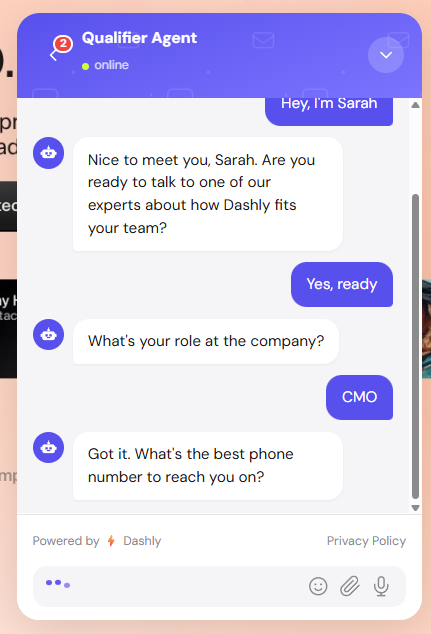
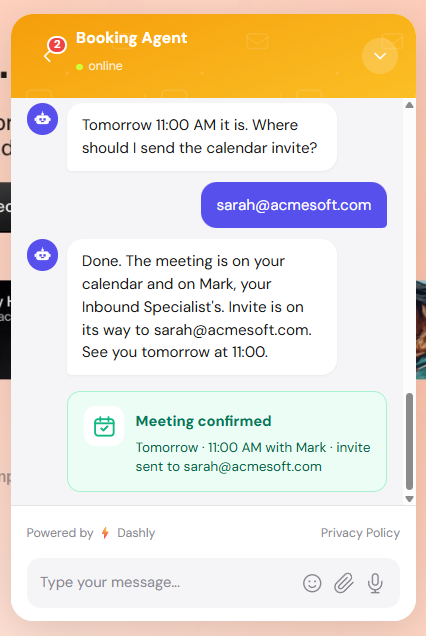
Here’s how Dashly’s AI agent qualifies a visitor on the website:

When to use a sales funnel vs a pipeline
The practical split comes down to the decision you are making. Use the funnel for marketing decisions. Use the pipeline for sales decisions. Both should exist in a healthy revenue operation because they answer genuinely different questions for genuinely different team leads.
Use the funnel when you need to:
- Plan a campaign calendar based on buyer stage (TOFU, MOFU, BOFU)
- Evaluate which acquisition channels produce the highest-quality MQLs
- Diagnose a conversion drop between funnel stages
- Set marketing targets: MQL volume, MQL-to-SQL rate, cost per MQL by channel
Use the pipeline when you need to:
- Forecast this quarter’s revenue from deals already in progress
- Identify which deals are at risk of stalling or slipping
- Evaluate sales rep performance: deal count, average deal size, win rate
- Align sales capacity to current deal volume
A CMO reviewing funnel data and a Head of Sales reviewing pipeline data can hold completely different views of business health without either being wrong. The funnel can show healthy conversion rates while the pipeline shows thin deal volume because of a qualification mismatch. Looking at both together is the only way to see the full picture.
Common mistakes when you confuse funnel and pipeline
Treating funnel and pipeline as synonyms creates specific, measurable errors. These are the three most common, each with a direct impact on revenue.
Mistake 1: Using funnel conversion rates to forecast deal revenue.
Funnel conversion rates measure how many anonymous visitors become MQLs. They don’t tell you how many will close, at what value, or when. Teams that use funnel data to build revenue forecasts consistently overestimate because they are counting leads, not qualified opportunities with stage probabilities attached. Revenue forecasting belongs in the pipeline, using SQL-to-close rate and average deal value, not funnel-to-MQL volume.
Mistake 2: Applying pipeline stage logic to marketing campaigns.
Marketing campaigns don’t have a “negotiation” stage. When marketing teams map their nurture emails to pipeline stage labels, they build campaigns that feel transactional and premature to buyers still in the consideration phase. Pipeline stage thinking assumes a deal is already in progress. Funnel thinking assumes the buyer is still deciding whether to engage at all. These are two completely different psychological moments that require completely different messaging.
Mistake 3: No shared ownership of the MQL-to-SQL handoff.
When marketing owns the funnel and sales owns the pipeline, the transition between them belongs to nobody. A lead that hits MQL criteria sits in a queue until a sales rep checks it. This is not a motivation problem. It is a structural one. The solution is a defined SLA for the handoff, automated first touchpoints, and a shared dashboard that makes the gap visible to both teams in real time.
Tools that manage funnels and pipelines
Funnel tools and pipeline tools are built for fundamentally different jobs. Using a pipeline tool to measure marketing performance, or a marketing tool to forecast deal revenue, gives you bad data and broken workflows. Here is how each category maps to its function.
Funnel tools (marketing stack). Marketing automation platforms such as HubSpot Marketing Hub, Marketo, and ActiveCampaign manage email sequences, lead scoring, and behavioral tracking. Landing page builders and on-site engagement tools capture and qualify leads at the top of the funnel. Analytics platforms connect campaign spend to MQL volume by channel.
Pipeline tools (sales stack). CRM systems such as Salesforce, HubSpot CRM, and Pipedrive are the canonical home of the pipeline. Sales engagement platforms like Salesloft and Outreach manage structured follow-up sequences from within the pipeline context. Revenue intelligence tools surface deal risk from call and email data, helping managers prioritize before deals slip.
The bridge: AI agents. The gap between the two stacks, the MQL-to-SQL handoff, is where most inbound pipeline leaks. Leads qualify in the marketing stack but don’t immediately trigger action in the sales stack.
Dashly’s AI Inbound Revenue Agent sits at this boundary. When a visitor qualifies as an MQL based on your ICP criteria, the agent engages them in real time, runs qualification using your defined questions, books a meeting if they qualify, and pushes the deal record directly into your CRM. The handoff happens in minutes, not hours or days.
See how the AI qualifier agent handles the funnel-to-pipeline transition for B2B inbound teams:


Conclusion
Sales funnel and pipeline are not the same thing. Treating them as interchangeable produces wrong revenue forecasts, misaligned team KPIs, and a structural leak at the most important handoff point in the inbound process.
Three things to take forward. The funnel belongs to marketing: it maps the buyer’s journey and measures demand quality at scale. The pipeline belongs to sales: it tracks individual deal progress and drives revenue forecasting. The handoff between them is where most B2B teams lose qualified pipeline, and designing that handoff deliberately is the highest-leverage investment in inbound revenue.
If your MQL-to-SQL conversion is slow or opaque, the funnel-to-pipeline gap is likely the culprit. Dashly’s AI Inbound Revenue Agent is built for exactly this: real-time qualification, instant handoff, no leads left in a queue.
No. A sales funnel tracks the buyer’s journey from awareness to purchase and is owned by marketing. A sales pipeline tracks the seller’s process for moving qualified deals toward close and is owned by the sales team. The funnel feeds the pipeline, but they measure different things with different metrics.
No. A pipeline shows deal stages from the seller’s perspective: how many deals are at each stage, their combined value, and the probability of closing. A funnel shows buyer stages from the prospect’s perspective: how many people are at each stage of awareness, consideration, or decision. Both are necessary, but they answer different questions.
A standard B2B SaaS pipeline includes: lead qualified, discovery call booked, proposal sent, evaluation, negotiation, and closed won or closed lost. The exact stage names vary by organization and CRM setup, but each stage represents a specific seller action, not a buyer mindset.
The funnel feeds the pipeline. Prospects move through awareness, consideration, and decision stages in the funnel. When they reach the MQL threshold, they exit the funnel and enter the pipeline as Sales Qualified Leads. The MQL-to-SQL handoff is the critical transition point, and effective B2B teams automate it to eliminate response delays.
No. The funnel model remains the most practical framework for mapping buyer behavior at scale. What has changed is the speed and tooling: AI-driven qualification, real-time engagement, and automated handoff to the pipeline mean the funnel runs faster and leaks less than it did five years ago.
Deploy an AI Inbound Revenue Agent at the point where MQL criteria are met. The agent engages the lead in real time, qualifies using your ICP criteria, books a discovery meeting, and creates the deal record in your CRM without a human rep having to check a queue. Dashly’s AI Inbound Revenue Agent handles this transition: real-time qualification from the funnel, immediate handoff to the pipeline.
A sales process is the set of steps a seller follows to close a deal, which aligns closely with the pipeline. A sales funnel describes how buyers move through stages of awareness and consideration, which is a marketing-side model. The funnel maps buyer behavior; the sales process maps seller behavior.