11 agentic AI marketing examples from real companies (2026)
 15 minutes
 10.06.2026
McKinsey estimates that agentic AI could eventually handle two-thirds of all marketing activities at full deployment. Most CMOs are still asking whether it actually works in the real world, not just in vendor decks.
This article answers that question with 11 live deployments: companies that have shipped AI agents to production with the numbers to back it up. Greenhouse booked 2,000 meetings with $27M in influenced pipeline. U.S. Bank grew lead conversion by 260% in four months. Sephora lifted email open rates by 80%. Unilever cut content production costs by 55%.
Each example covers what the company deployed, how the agent works in the funnel, and the result it produced. The article also includes a realistic ROI picture, a five-phase deployment plan, and a clear read on what typically fails.
What is agentic AI in marketing?
Agentic AI in marketing refers to autonomous systems that perceive context, set their own sub-goals, execute multi-step actions across tools, and adapt based on results without a human defining each step. Unlike a chatbot that waits for input or an automation rule that follows a fixed sequence, an agentic system reasons about what to do next and self-corrects when outcomes fall short. Three markers define a truly agentic system: it is goal-directed, it orchestrates multiple tools, and it self-corrects.
Without all three, it is automation with better branding.
The term comes from AI research on agent architectures: systems that perceive their environment, plan a sequence of actions toward a goal, and execute. In marketing, the environment is your inbound funnel, CRM, email platform, and ad tools. The agent’s job is to move a lead from their current state to the desired next step, handling the micro-decisions that humans make manually today.
What separates an agentic system from a smart automation is the presence of goal-directed reasoning. The agent receives an objective, breaks it into sub-goals, chooses which tools to use, executes the steps, observes the outcome, and adjusts if the result falls short. A standard automation platform cannot do any of those last three.
What agentic AI is not: a faster if-then automation.
A trigger-based sequence that fires a welcome email when someone fills a form is not agentic. An agent identifies a high-intent visitor, decides what message to show, qualifies them against ICP criteria, routes them to the right team, and schedules a meeting on its own. The difference is who makes the micro-decisions.
For a deeper look at how agentic marketing connects to revenue strategy, that piece covers the full picture across the funnel.
Agentic AI vs. marketing automation: the key difference
Agentic AI differs from marketing automation in one critical dimension: who decides what happens next. Automation executes a sequence a human defines in advance. An agentic system defines its own sequence based on the current state, the goal, and available tools. That difference compounds across millions of customer interactions and is the reason the performance gap between the two systems widens with scale.
Take an abandoned cart.
A standard automation platform fires a fixed sequence: wait one hour, send email 1; wait 24 hours, send email 2; wait 72 hours, send SMS. It runs the same sequence regardless of whether the customer already bought through another channel, visited the pricing page three more times since, or unsubscribed from email.
An agentic system checks the current customer state first. It detects the cross-channel purchase and suppresses the sequence. It spots the three pricing-page visits and escalates the lead to an SDR instead. It identifies the unsubscribe and switches to in-app messaging. Every decision is made fresh against the current state.
According to McKinsey, companies that redesign workflows from scratch for agentic AI are three times more likely to see measurable EBIT impact than those that layer new tools on top of existing automation.
| Marketing automation | Agentic AI | |
| Goal-setting | Human defines rules for every case | Agent sets sub-goals within a defined objective |
| Decision-making | Fixed if-then logic | Reason, act, evaluate, adapt |
| Multi-tool orchestration | Single-platform sequences | Cross-platform, cross-channel |
| Adaptation | Requires manual rule updates | Adapts based on results |
| Human involvement | High; rules must cover every edge case | Low; set objectives and guardrails |
11 agentic AI marketing examples from real companies
The examples below come from publicly documented deployments. Each includes the company, the agent’s role in the funnel, and the reported outcome. Sources are linked where available.
1. Inbound qualification agent: Tranio + Dashly
Tranio is an international real estate broker with average deal sizes between €400K and €1.5M. High-intent buyers, real estate brokers, and early-stage researchers all looked identical in analytics. SDRs were spending time on leads that would never convert while ready-to-buy prospects slipped through.
Dashly deployed a team of AI agents to transform the inbound funnel. The system engages a visitor in the conversation with a personalized message based on their behavior.
Once a visitor engages, an AI SDR qualifies them in real time based on budget, timeline, purchase intent, and buyer type, giving the sales team a clear signal for who to call first.
Here’s what the qualification process looks like:
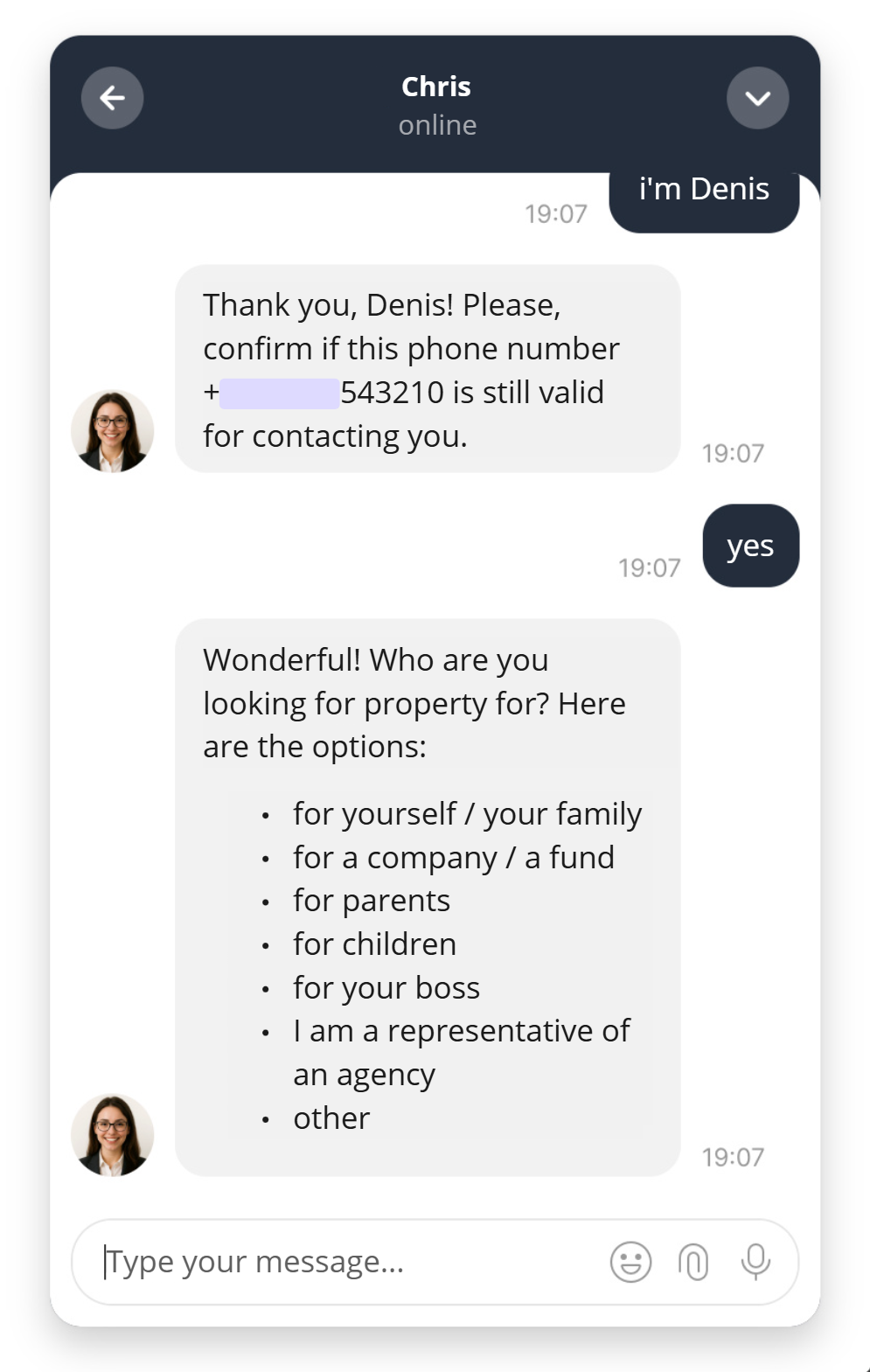
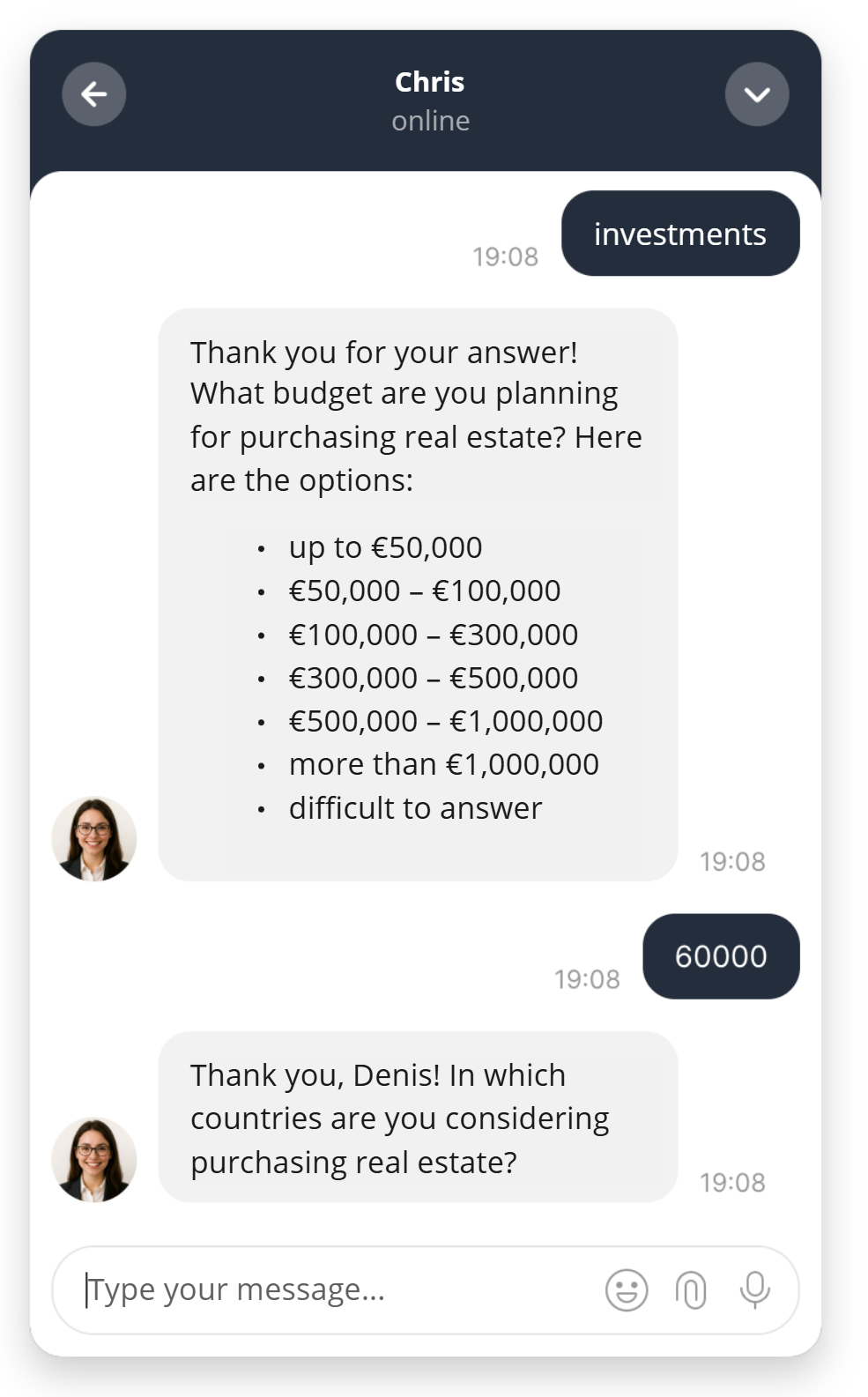
Before every consultation, an AI Agent Insight generates a pre-call brief for the manager: intent signals, qualification data, conversation highlights, and a readiness score. The manager reads it in one minute and opens the call with full context.
Results: Visitor-to-lead conversion doubled. MQL conversion grew by 50%. AI agents drove 76% of all Zoom calls booked through Dashly scenarios and contributed to 20% of all closed deals.
Read the full Tranio case study for the detailed funnel breakdown.

2. Inbound pipeline agent: Greenhouse + Qualified
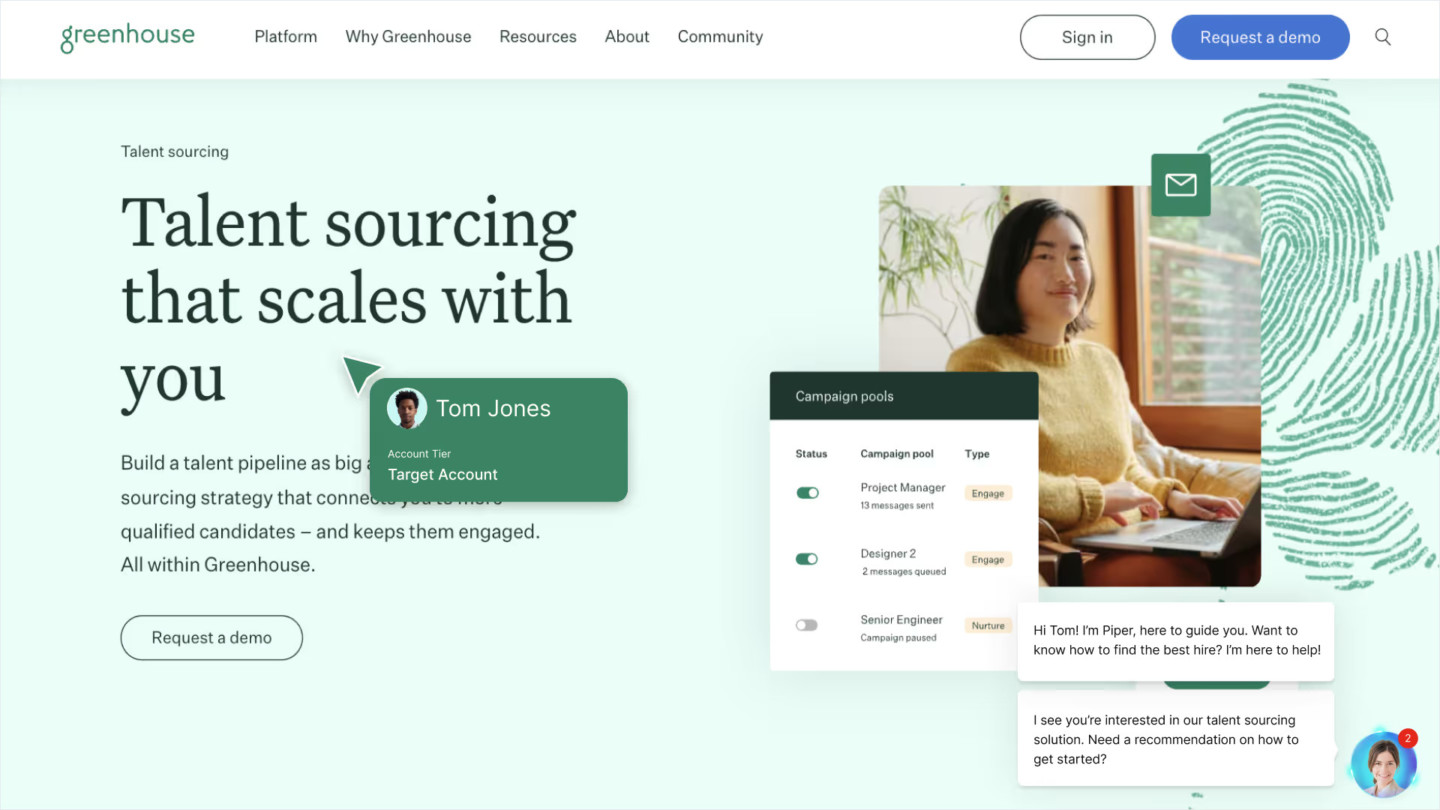
Greenhouse, an applicant tracking system company, deployed Piper, Qualified’s AI SDR agent, to engage inbound website visitors, qualify them against ICP criteria, and book meetings autonomously, 24 hours a day. In the first year, Piper booked 2,000 meetings, influenced $27M in pipeline, and contributed to $4M in closed-won revenue.
3. Chat resolution agent: 1-800-Accountant + Salesforce Agentforce
1-800-Accountant deployed Salesforce Agentforce to handle inbound customer inquiries autonomously during peak periods. During tax week, when support volume spikes and staffing stays fixed, the agent handled 70% of chats without human intervention, covering routine questions, document requests, and status updates while human staff focused on complex cases.
4. Predictive lead scoring agent: U.S. Bank + Salesforce Einstein
U.S. Bank deployed Salesforce Einstein to analyze over 200 data points per lead for predictive scoring and routing across its commercial banking division, replacing a manual qualification process that created delays and inconsistency. In four months, lead conversion grew by 260% and the average sales cycle shortened by 35%.
5. Lifecycle decisioning agent: Sephora + Optimove
Sephora deployed Optimove’s AI Decisioning agent to select the optimal message for each customer across channels and across the full customer lifecycle, replacing human-predefined segments with per-customer autonomous decisions on message, channel, timing, and offer.
Results: 80% higher email open rates versus non-personalized sends, 11% more sales, 30% fewer returns.
6. Email personalization agent: Cleo + BrazeAI
Cleo, a financial management app, replaced a rule-based welcome series with BrazeAI Decisioning, a dynamic sequence that adapts messaging based on each user’s behavior and engagement signals. The shift produced an 81% reduction in unsubscribes, a 284% increase in app opens, and a 124% lift in push notification engagement.
7. E-commerce campaign agent: 24S (LVMH) + BrazeAI
24S, LVMH’s multi-brand luxury e-commerce platform, deployed BrazeAI to run autonomous abandoned-cart and low-stock urgency campaigns. The agent decides when to trigger a campaign, which message to use, and which channel to send through, based on behavioral signals and inventory status. In a three-day measurement window, purchase conversion rate grew by 35% and add-to-cart actions increased by 7%.
8. Content production agent: Unilever + Google Cloud Vertex AI
Unilever deployed a multi-agent content workflow on Google Cloud Vertex AI to produce and brand content across more than 400 global brands, a scale that made human-led production economically unworkable.
Outcome: 55% reduction in content production costs, 65% faster time-to-publish, and AI-generated images that held viewer attention three times longer than standard creative.
9. Autonomous ad targeting agent: Coca-Cola
Coca-Cola deployed an autonomous targeting agent across TikTok, LinkedIn, and Pinterest to identify fast food consumers and deliver coupon-based advertisements without direct marketing team involvement. The agent scanned platform signals, identified the target audience, and served creatives autonomously. In one deployment window, it executed 8 million actions and delivered 828,000 coupon ads.
10. ABM intent-driven pipeline agent: Socure + 6sense
Socure, an identity verification company, deployed 6sense’s RevvyAI platform to monitor intent signals across target accounts continuously, qualify accounts against ICP criteria, and route high-intent signals to the right sales team members without human involvement at the qualification step. In the first year, the program drove $52M in attributed pipeline. By the first half of 2025, that figure had reached $98M.
11. Churn prevention agent: Verizon
Verizon deployed a predictive AI agent to forecast the reason for an inbound customer call before the call connects, then route it to the right team with pre-loaded context. The result: approximately 100,000 customers retained and 7 minutes less time spent per store visit.
What results can you realistically expect?
The results in these 11 examples range from a 35% conversion lift for e-commerce campaigns to 260% for predictive lead scoring. That range is not random. It reflects how much of the existing process was manual, how high the baseline volume was, and how well the data foundation supported the agent’s decisions.
McKinsey puts the revenue potential at 10 to 30% growth for organizations that fully redesign workflows rather than patch existing ones. Campaign creation time can compress by 10 to 15 times. Organizations that redesign workflows from scratch for agentic AI are three times more likely to see measurable EBIT impact than those who layer new tools on top of existing automation.
Gartner warns that only around 10% of CMOs currently report measurable results from their AI deployments, and that 40% or more of agentic AI projects will be cancelled by 2027. The gap between pilot and production is real.
What determines which side of that gap you land on: data foundation quality, use-case selection (high volume and low complexity first), and guardrail design. The five-phase plan below addresses each of those.
How to deploy agentic AI in your marketing team
Five phases, in order. Compressing or skipping any of them is the leading cause of failed pilots.
Phase 0 (weeks 1–4): Data readiness
Most agentic AI pilots fail before a single agent is deployed. Audit every data silo: CRM, CDP, email ESP, ad platform, and web analytics. Identify where there are missing fields, inconsistent tagging, or no real-time sync between systems. An agent that makes decisions on incomplete data will make confidently wrong decisions at scale.
For B2B SaaS teams working with AI agents, this step typically surfaces two to three months of data cleanup work that nobody knew existed.
Phase 1 (weeks 2–6): Use-case selection
Start with high-volume, low-complexity tasks where mistakes have a low cost. Inbound chat qualification and email send-time optimization are the two most common first deployments. Do not start with tasks that require brand judgment: brand voice copy, PR responses, or executive communications.
The test for a good first use case: the agent makes the same decision a skilled SDR or marketer would make, just faster and at higher volume.
Phase 2 (weeks 4–8): Platform selection
Different use cases need different platforms. A rough map:
- Inbound pipeline and qualification: Qualified, Dashly
- Lifecycle messaging and decisioning: Braze, Optimove
- ABM and intent-based routing: 6sense
- Content generation and workflows: Writer, HubSpot Breeze
- Paid advertising optimization: Meta Advantage+, Google AI Max
For a broader comparison, the AI SDR tools page and the AI marketing tools comparison cover the current vendor landscape in detail.
Phase 3 (weeks 6–10): Guardrails setup
Define what the agent decides autonomously and what it escalates. Add a brand-safety classifier to any agent that produces copy. Require source attribution for any factual claim an agent makes. The most common guardrail mistake: setting them so broadly that the agent escalates everything back to a human. A good guardrail covers the 5% of edge cases that genuinely need review, not the 80% of routine decisions.
Phase 4+ (month 3 onward): Pilot, then scale
Run the first deployment against a control group. Measure one primary KPI: meetings booked, pipeline influenced, or email revenue per user. Scale only after the KPI is positive and the data is statistically significant. The companies in these 11 examples that produced the largest results got there by running one agent well, then adding the next.
Risks and what can go wrong
The 11 examples above represent deployments that worked. Here is what the failures look like.
Hallucinations in published content. In May 2025, the Chicago Sun-Times and Philadelphia Inquirer both published a summer reading list that included books that do not exist. The authors used AI to generate the list without fact-checking the output. The pattern is identical to AI-assisted content marketing at scale. Any agent producing customer-facing copy needs a fact-check step before publish.
The ROAS paradox in paid ads. Meta Advantage+ produces an average 4.52x ROAS across deployments. But an analysis of 55,000 campaigns by Wicked Reports found that cost per new customer grew from $257 to $528 over the same period. The agent was optimizing for conversions globally and cannibalizing retargeting spend. High ROAS from an autonomous ad agent does not always mean efficient new customer acquisition.
Brand voice drift at scale. When an agent produces thousands of outputs without regular calibration, brand voice diverges incrementally. No single output looks wrong, but the aggregate diverges from brand standards over time. Build a calibration checkpoint into any content-producing agent at least once per quarter.
Agent washing. Gartner estimates that of the thousands of vendors now using the label “agentic AI,” only around 130 offer genuine agentic functionality. The test: does the system set its own sub-goals, orchestrate multiple tools, and adapt based on results? If not, it is automation with a rebrand.
Gartner warns that 40% or more of agentic AI projects will be cancelled by 2027 due to inadequate risk controls and weak data foundations. The projects that survive are those that built guardrails before they built scale.
How Dashly’s AI agent handles inbound
The Tranio example above shows Dashly’s agent team in a high-ticket real estate context. The same agent system works for B2B SaaS: anywhere that inbound traffic needs qualifying and routing without adding SDR headcount.
The agents cover the full inbound flow: proactive engagement triggered by behavioral signals, 6-tier qualification based on budget, timeline, and purchase intent, and a pre-call brief generated for the sales rep before every consultation.
Here’s what it looks like:
Step 1: Engagement
Step 2: Qualification
Step 3: Booking
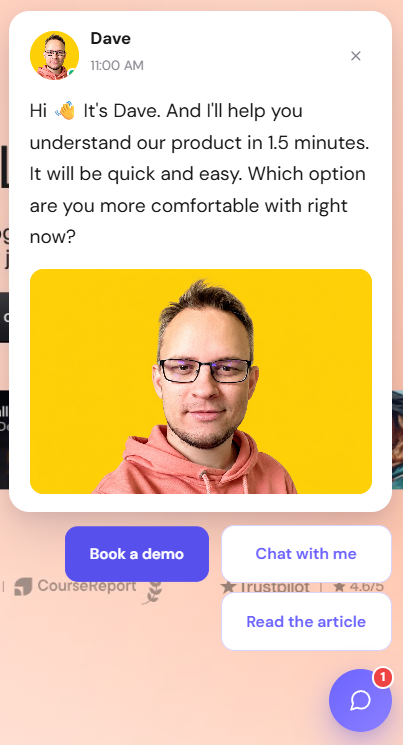
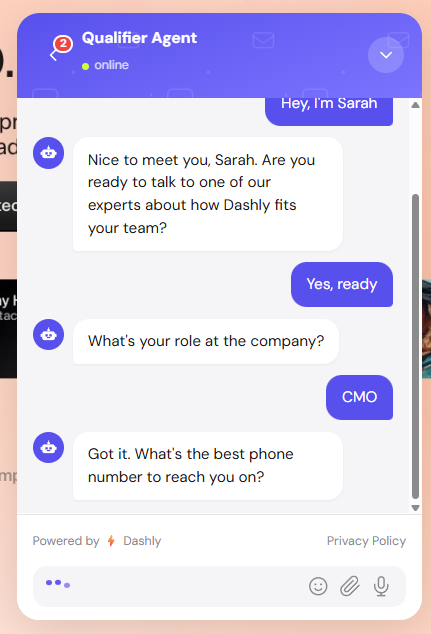
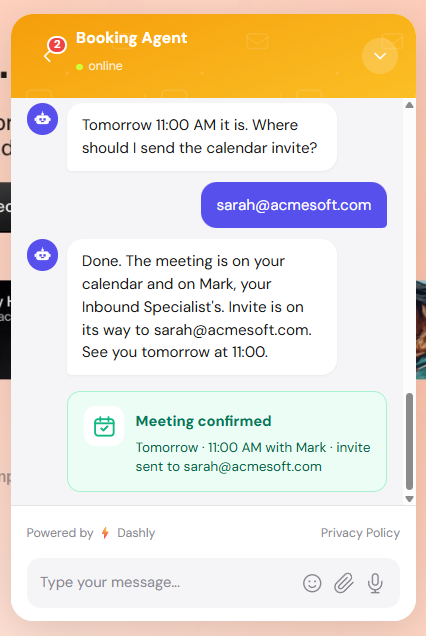
If you want to see how those agents would work in your specific funnel, the 15-minute walkthrough covers a live setup.
Conclusion
The 11 deployments in this article share one pattern: the teams that produced the largest results started with a single, high-volume use case and ran it well before expanding.
Four things are clear from the data. Agentic AI is already in production at Dashly, Greenhouse, Sephora, U.S. Bank, and Coca-Cola. This is not a future state. Companies that fully redesign workflows for agentic systems outperform those who layer new tools on top of existing automation. Agentic is not a synonym for automation. The difference is in who makes the micro-decisions, and how. And 40% of agentic AI pilots will be cancelled by 2027 per Gartner, but the ones that survive are those that built the data foundation and guardrails first.
The jump from pilot to production takes 1-3 months. Walk through a live setup.
Dashly’s AI agent team at Tranio is one of the most documented examples: autonomous agents engage inbound visitors, qualify leads across a 6-tier scoring system, and brief managers before every call, 24/7. Results: visitor-to-lead conversion doubled, MQL conversion grew 50%, and 76% of Zoom calls were generated through Dashly scenarios. Qualified’s Piper AI SDR is another clear case: Greenhouse booked 2,000 meetings with $27M in influenced pipeline in its first year.
The five most-adopted use cases: inbound pipeline management from chat to meeting booking, lifecycle personalization and email decisioning, predictive lead scoring and routing, autonomous content generation, and paid ads optimization. Each involves an AI agent that sets its own sub-goals across multiple tools without a human defining each step.
The four risks that appear most in failed deployments: hallucinations in published content when no fact-check step exists, ROAS optimization that cannibalizes new customer acquisition, brand voice drift at scale without regular calibration, and buying automation relabeled as agentic AI. Gartner estimates 40% or more of agentic AI projects will be cancelled by 2027.
Marketing automation runs rules a human defines. Agentic AI sets its own sub-goals, orchestrates multiple tools without predefined sequences, and adapts strategy based on results. The structural difference is in who decides what happens next at each step in the process.
McKinsey puts the revenue potential at 10 to 30% growth for organizations that redesign workflows from scratch. Specific results from documented deployments: U.S. Bank saw 260% more lead conversions in four months; Greenhouse influenced $27M in pipeline in year one; Tranio doubled visitor-to-lead conversion and 20% of all closed deals now involve AI agents. Timeline from pilot to measurable ROI: typically three to nine months.