Agentic AI in marketing: Use cases, examples, and how to get started in 2026
 16 minutes
 10.06.2026
Most B2B marketing teams operate with a 24-to-48-hour response window on inbound leads. A prospect visits your pricing page at 11pm, fills out a form, and gets a confirmation email promising someone will be in touch. By morning, they’ve booked a demo with two competitors.
That is a process problem, and agentic AI in marketing fixes it at the source.
This article explains what agentic AI in marketing is, how it differs from the automation and AI tools most teams already use, and where the clearest use cases sit today. By the end, you’ll have a framework for deciding where to start.
What is agentic AI in marketing?
Agentic AI in marketing is a category of AI systems that pursue defined goals by planning and executing multi-step tasks autonomously, without per-step human instruction. Unlike rule-based marketing automation, which executes predefined sequences, or generative AI, which produces content when prompted, an agentic system decides how to reach a goal and acts on that decision in real time.
The word “agentic” comes from “agency” — the capacity to act independently. In a marketing context, that means an AI system can receive an objective, such as “qualify all inbound leads on the pricing page,” and determine the method on its own: which questions to ask, when to escalate, when to book a meeting, how to log the outcome.
Agentic AI = autonomy + goal orientation + adaptability. A traditional chatbot responds to triggers. An agentic AI system sets plans, uses tools, and adjusts when conditions change.
Three properties define agentic AI systems:
- Autonomy — acts without per-step human instruction
- Goal orientation — works toward an outcome, not just an action
- Adaptability — adjusts its plan based on new information
These properties make agentic AI particularly valuable in marketing, where customer journeys are non-linear and the difference between a qualified lead and a missed opportunity often comes down to timing and context.
For a broader look at how agentic AI connects to marketing strategy, see agentic marketing.
Agentic AI vs generative AI vs marketing automation: what’s the difference
The three terms are often conflated. They describe different capability levels, and mixing them up leads to mismatched expectations and wrong tool choices.
| Rule-based automation | Generative AI | Agentic AI | |
| How it decides | Follows preset rules | Responds to prompts | Plans and decides autonomously |
| Scope per interaction | One trigger, one action | One prompt, one output | Multi-step, multi-tool execution |
| Human oversight needed | To write every rule | To review every output | To set goal and guardrails |
| Primary marketing use | Email sequences, lead scoring | Copy generation, image creation | Lead qualification, journey orchestration |
Here’s the same scenario across all three, to make the difference concrete.
A prospect fills in a “Request pricing” form at 11:30pm.
Rule-based automation sends a confirmation email and adds the lead to a three-email nurture sequence. No conversation happens.
Generative AI drafts a personalized follow-up email when SDR prompts it to. No action happens until a human clicks send.
Agentic AI starts a qualifying conversation immediately: asks about company size, current tool stack, decision timeline. Scores the lead against ICP criteria. Books a 9am demo if the lead qualifies. Alerts the assigned rep with full conversation notes. The rep walks into the meeting with context, not a cold lead.
The practical implication: agentic AI adds the most value in high-volume, time-sensitive workflows where human latency costs pipeline.
Key use cases of agentic AI in marketing in 2026
Agentic AI creates measurable value in five specific marketing workflows. Each shares a common condition: it happens at high volume, and the speed of execution directly affects revenue outcomes.
Lead qualification and inbound pipeline
Lead qualification is the highest-ROI starting point for most B2B marketing teams. When a prospect visits your pricing page, requests a demo, or starts a free trial, every hour of delay before a qualifying conversation reduces conversion probability. Agentic AI eliminates that delay entirely.
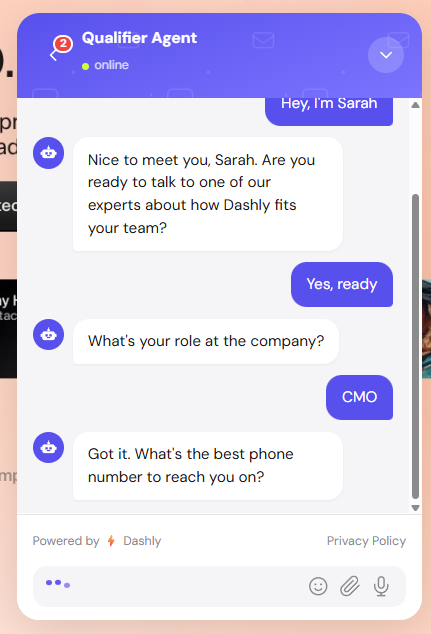
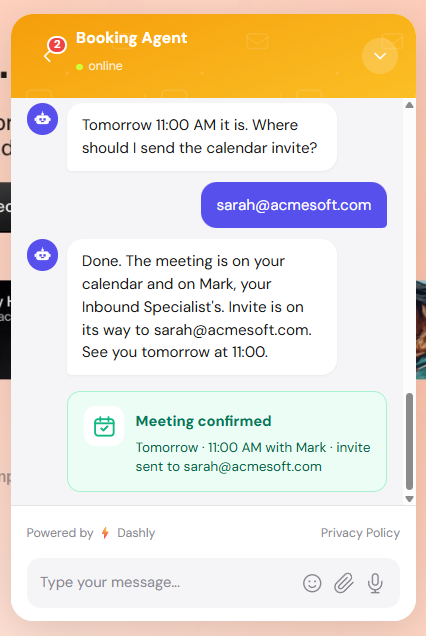
An AI inbound agent engages the visitor in a qualifying conversation on contact, asks ICP-relevant questions, scores the lead, and routes qualified prospects to a live calendar booking flow. Non-qualified leads get directed to self-serve resources. The sales rep receives the conversation transcript before the first human interaction.
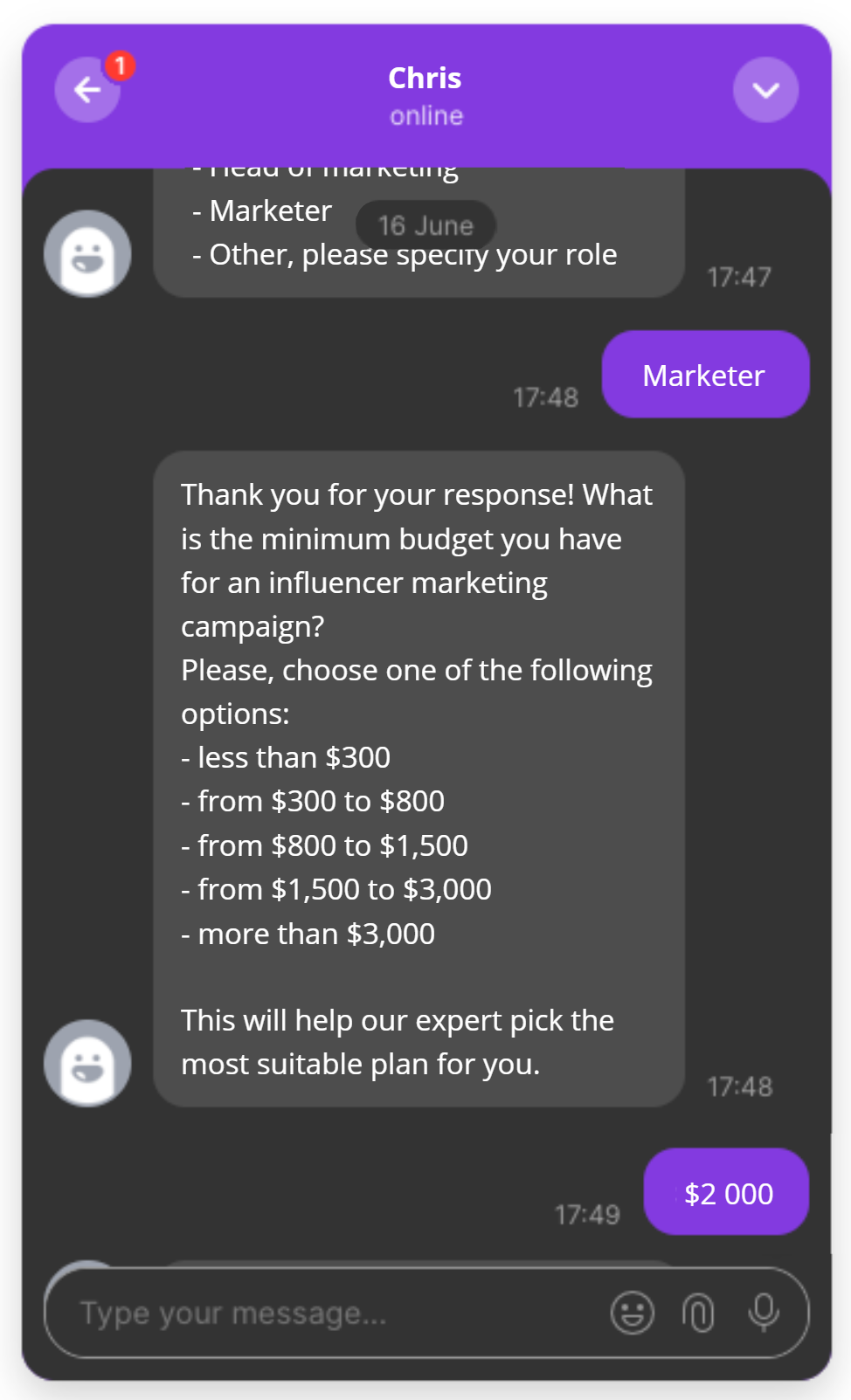
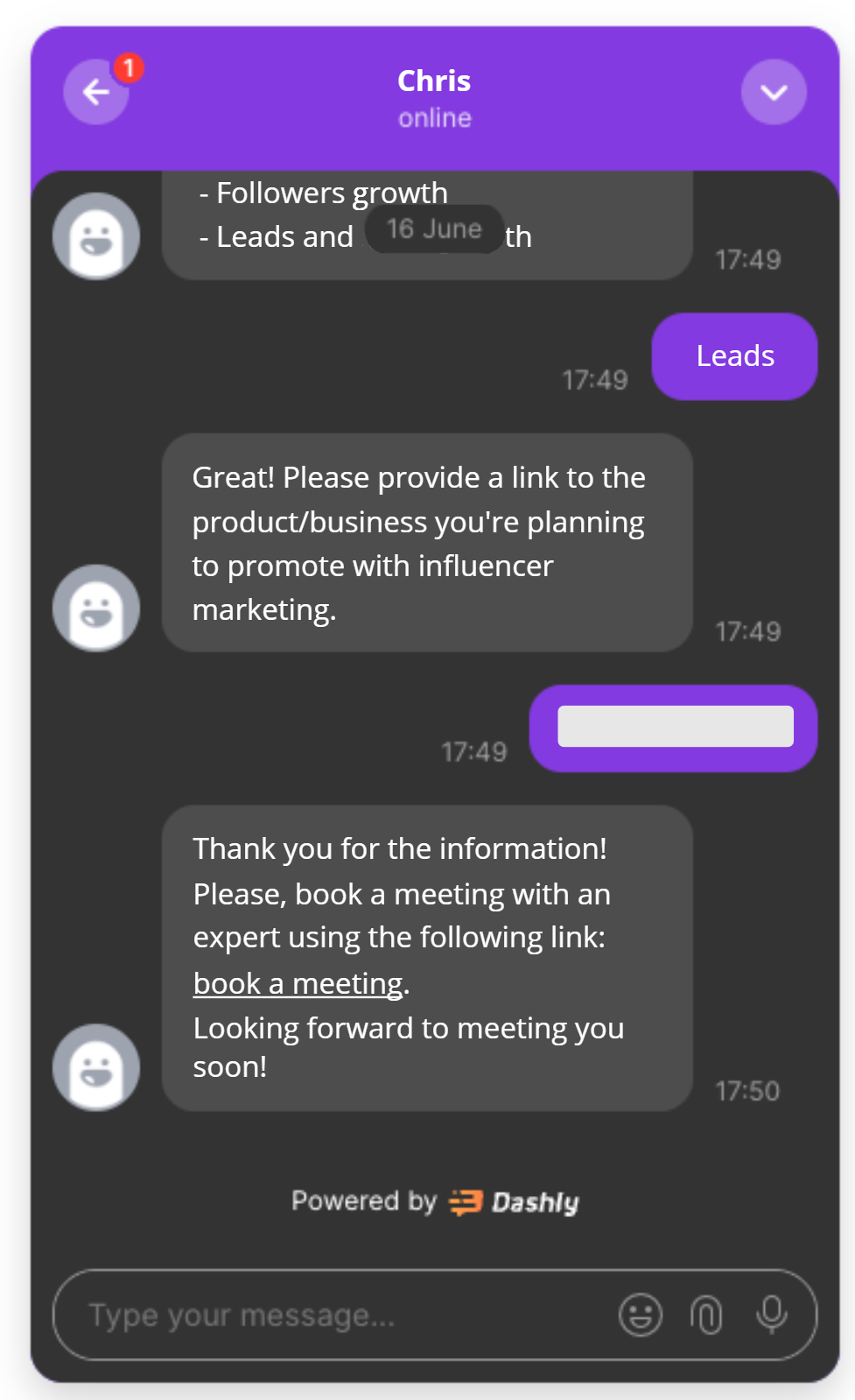
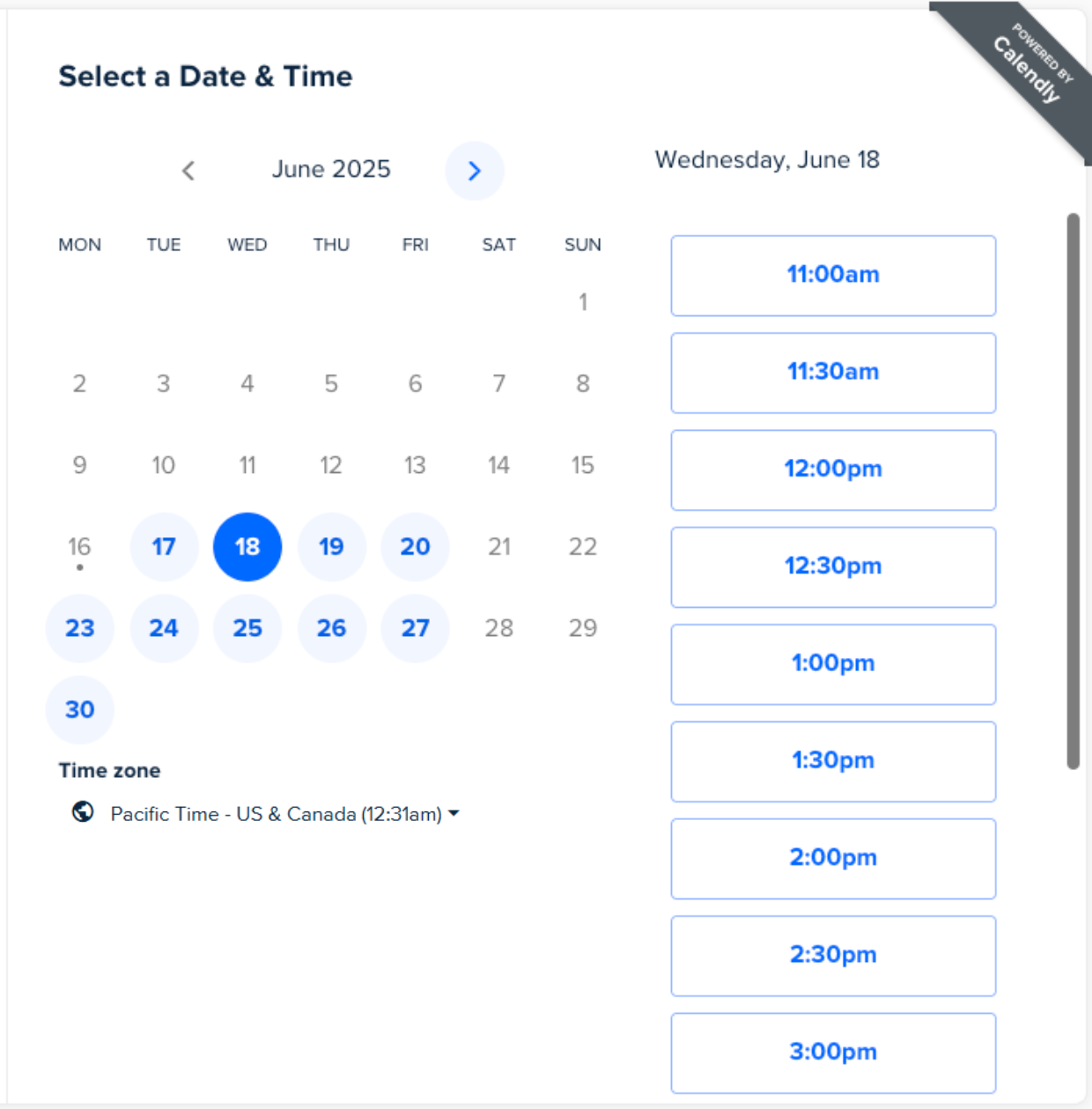
Here’s how Dashly’s AI agent qualifies a visitor on the website:
Step 1: Engagement
Step 2: Qualification
Step 3: Booking

AI SDR tools built on agentic AI are the fastest-growing segment in B2B sales technology in 2026 for exactly this reason. For context on where lead qualification sits in the broader revenue motion, see pipeline generation strategy.

Personalized content delivery at scale
Standard personalization tools match a visitor to a segment and serve a preset content variant. Agentic personalization works differently: the agent monitors session behavior in real time, infers intent from the combination of pages visited, time spent, and source channel, and selects content dynamically.
Here’s an example of personalized communication base don user behavior:
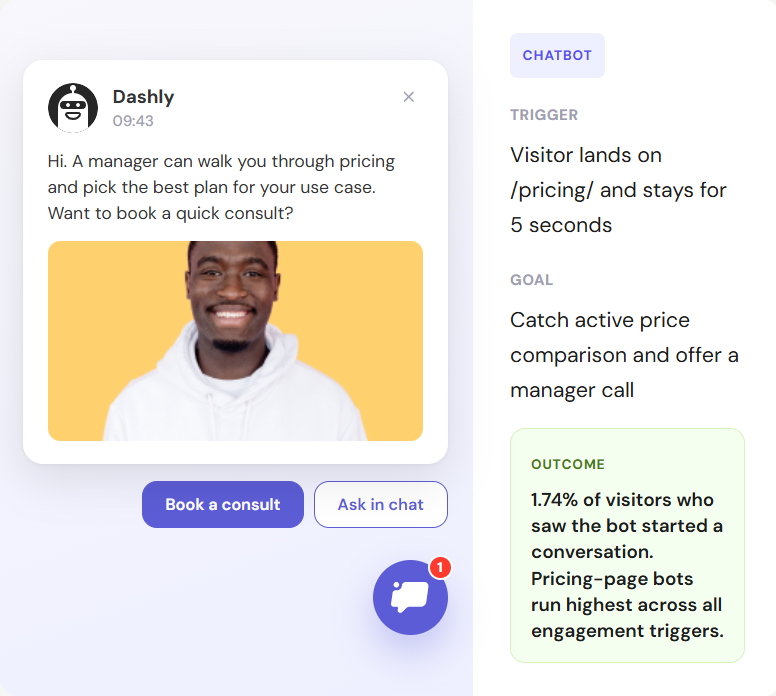
The practical difference is resolution. Segment-based personalization serves the right message to a visitor type. Agentic personalization serves the right message to this visitor now. That precision matters most for high-value prospects where a single misaligned content moment can cause a bounce.
Campaign budget optimization
Agentic campaign optimization means the AI monitors ad performance data and makes budget decisions continuously, not weekly. It pauses underperforming variants, reallocates budget to top performers, and adjusts targeting parameters. But it acts within the guardrails the team sets.
For teams running campaigns across multiple platforms simultaneously, this removes the latency between “the data shows this placement is underperforming” and “we’ve made the adjustment.” That latency is where budget waste lives.
Customer journey orchestration
Customer journey orchestration is the most complex agentic marketing use case. The AI monitors a prospect’s behavior across email, website, paid retargeting, and chat, and determines the next best action based on the current CRM state.
- If a prospect opens three product emails without booking a call, the agent triggers a direct outreach.
- If they’ve been stuck at the trial stage for two weeks, it surfaces the case study most relevant to their industry segment.
- No human needs to review individual records to trigger these actions.
The key difference from traditional journey mapping: the agent doesn’t require every path to be pre-configured. It responds to what’s actually happening, which means it handles edge cases that rule-based systems miss entirely.
Content marketing automation
Agentic AI for content marketing handles the upstream production work: keyword research, competitive analysis, outline generation, first draft. The agent identifies gaps in your content coverage, proposes a structure based on SERP patterns, and produces a draft for human editing.
This doesn’t replace the editor or subject matter expert. It shifts where their time goes: from blank-page production to review and refinement. Teams that adopt this model consistently report that the bottleneck moves from content creation to content quality control, which is the right bottleneck to have.
Real-world examples of agentic AI in marketing
B2B SaaS: inbound lead response
A B2B SaaS company in the influence marketing space was losing qualified leads to faster competitors. Sales reps responded to inbound requests within 24 to 48 hours. By the time the first call happened, the prospect had already booked demos with two or three other tools.
They deployed an AI inbound agent on their pricing and demo-request pages. The agent engaged visitors in a qualifying conversation within seconds, asked ICP-specific questions (if they were bloggers or advertisers, how much budget they had etc.), and routed qualified leads directly to a calendar booking flow.
First-response time dropped from 24 hours to under 90 seconds on qualifying interactions. Lead-to-meeting conversion increased within the first 60 days with no change in sales headcount.
For more on how AI transforms customer-facing interactions at scale, see automated customer service examples.
B2B SaaS: campaign budget optimization
A B2B software company running paid campaigns across Google and LinkedIn was doing monthly budget reviews. By the time an underperforming campaign was adjusted, 30 to 40 percent of that month’s allocation had already been spent on low-converting variants.
After deploying an agentic optimization layer, the system monitored daily performance against KPI targets and made micro-adjustments automatically: pausing variants below the CTR threshold, shifting budget from underperforming placements to top performers, and surfacing significant anomalies for human review.
Wasted ad spend decreased in the first quarter while overall pipeline volume held steady.
EdTech: content-driven inbound qualification
An online education company was generating strong organic traffic but converting under two percent of visitors to trial sign-ups. Visitors read articles and left without engaging further.
They added a contextual AI agent that triggered when a visitor spent more than three minutes on a how-to article. The agent offered a relevant resource download and qualified intent through a two-question form. Qualified leads (companies with 50+ employees seeking team tools) got an immediate follow-up sequence; individuals were routed to self-serve.
Trial sign-up conversion on content pages improved substantially within 45 days of deployment.
ROI of agentic AI in B2B marketing
Marketing leaders building the business case for agentic AI investment need metrics that are observable within a single quarter. Four metrics move most visibly with agentic deployment.
- Time to first response. The time between a lead expressing intent and a qualifying conversation starting. For B2B SaaS where decisions involve multiple stakeholders, the first company to have a substantive conversation with the decision-maker wins a disproportionate share of deals. This is the most directly improvable metric with an AI inbound agent.
- Lead qualification rate. What percentage of inbound leads meet ICP criteria. Agentic qualification doesn’t just speed up the process. It also reduces SDR time spent on leads that were never going to convert, which improves the effective cost per qualified lead even before speed improvements are counted.
- Pipeline velocity. The speed at which qualified leads move from first contact to closed won. Faster first response and better pre-meeting context both accelerate this. The sales rep who has conversation notes from the AI agent is more prepared than one starting cold.
- Cost per qualified lead. As agentic agents handle more top-of-funnel qualification, the same marketing budget produces more qualified pipeline. This metric tends to improve in the 60-to-90-day window after deployment.
For current vendor benchmarks and category comparisons, best AI B2B sales tools covers pricing and feature comparisons across the main tools in the market.
How to measure success in the first 90 days:
Focus on three metrics in the pilot window:
- First-response time: the before/after comparison on qualifying interactions
- Qualification rate: percentage of agent-handled conversations that convert to booked demos
- Sales rep preparation quality: what context reps have before their first meeting
These are measurable within the first sprint and give a clear signal about whether the deployment is working.
How to implement agentic AI in your marketing workflows
Teams that fail at agentic AI implementation tend to automate too much too fast. The teams that succeed start with one high-volume workflow, prove the model, then expand.
Step 1: Map one repetitive, high-stakes workflow.
Pick the workflow where a human is doing the same task repeatedly with high consequences: responding to pricing inquiries, qualifying demo requests, following up on content downloads. The right starting point has volume (more than 50 interactions per month), clear success criteria (booked meeting, qualified lead logged), and a defined set of inputs (visitor behavior, form submission, email open).
Step 2: Choose an agentic AI tool.
The AI marketing tools landscape has expanded significantly since 2023. When evaluating tools, prioritize CRM integration (does it write back to your system of record?), multi-channel execution (chat, email, SMS), guardrail configuration (how do you define what the agent can and cannot do?), and escalation protocol (how does the agent hand off to a human?).
For B2B inbound specifically, tools with native lead qualification and calendar booking integration show results faster than general-purpose platforms requiring extensive configuration.
Step 3: Define guardrails before deployment.
Guardrails keep the agent within its intended scope. Before launch, define which topics the agent can address vs. which require a human, the threshold that triggers an immediate escalation, tone and language rules the agent must follow, and which data the agent can access and act on. Start narrow. Expand guardrails as you validate agent behavior in production.
Step 4: Run a 30-day pilot on one channel.
Deploy on a single entry point — a pricing page, a specific form, one email flow. Log every interaction, review edge cases weekly, and track escalation frequency. The pilot’s purpose is not to prove that AI works. It’s to validate that this agent, with these guardrails, works for this workflow in your specific context.
Step 5: Measure and expand systematically.
After 30 days, you have real performance data. Use it to decide whether to expand scope, add channels, or adjust guardrails. The expansion decision should be data-driven, not driven by the original business case.
Risks and governance: what marketing teams need to watch
Agentic AI introduces failure modes that rule-based automation doesn’t have. Governance is not optional.
Off-brand messaging at scale. A rules-based system repeats the same message. An agentic system generates responses dynamically, which means a poorly constrained agent can produce on-brand content 90 percent of the time and significantly off-brand content 10 percent of the time, at a volume that makes manual review impossible. The fix: detailed tone and language guardrails at the prompt level, not just in tool settings.
Automation that removes personalization. The fastest implementation is to automate every customer touchpoint. The most effective implementation automates the right touchpoints. Companies that automate the full customer conversation often see CSAT scores drop — the agent handles the mechanics but strips the human judgment customers expect at key decision points. Keep humans in the loop for high-value deals, complex questions, and post-trial conversations.
Data privacy and compliance. Agentic systems that access CRM data, track visitor behavior, and store conversation history need clear GDPR compliance architecture. This is a precondition for deployment in any EU-facing marketing context, not an afterthought.
Hallucinated product claims. Generative AI components inside agentic systems can produce plausible-sounding but inaccurate product descriptions. Every customer-facing agentic system needs a grounding layer: explicit instructions about what the agent can assert about your product, plus regular audits of actual agent outputs.
How Dashly’s AI Inbound Revenue Agent works in marketing
Dashly’s AI Inbound Revenue Agent qualifies website visitors in real time, routes qualified leads to sales, and books demos automatically. It replaces the top-of-funnel SDR workflow without removing human judgment from the deal stage.
The agent engages visitors on high-intent pages (pricing, demo request, free trial) asks ICP-specific qualifying questions, and routes leads based on responses. Qualified leads get immediate calendar booking access. Non-qualified leads get directed to self-serve resources. The sales rep receives the full conversation transcript before any human interaction begins.

For B2B SaaS companies with high inbound volume and a standard 24-to-48-hour first-response cycle, the agent’s primary impact is on response time and lead-to-meeting conversion rate.
Conclusion
Agentic AI in marketing is not a technology trend to monitor. It’s an execution layer that removes latency and human limitation from high-volume, time-sensitive processes, so your team focuses on the judgment calls that require human expertise.
The companies winning with agentic AI in 2026 are not those who deployed the most agents. They’re the ones who identified the highest-value workflow, deployed correctly, and expanded based on performance data.
Start with inbound lead response time. That’s where the gap between agentic AI and everything else is most visible, and where the business case is easiest to make. A single deployment on your pricing page can show measurable results in 30 days.
For the strategy behind agentic marketing at the team level, see agentic marketing.
Agentic AI in marketing refers to AI systems that plan and execute multi-step marketing tasks autonomously, adapting their approach in real time to reach a defined goal. Unlike marketing automation that follows preset rules, or generative AI that produces content on demand, an agentic system can qualify leads, orchestrate customer journeys, and optimize campaigns without requiring per-step human instruction.
Marketing automation executes predefined rules: a form submission triggers a specific email, a page visit adds a tag, a score threshold moves a lead to a new stage. Agentic AI pursues a goal and determines the steps to reach it. It can hold qualifying conversations, make routing decisions based on those conversations, adjust tactics when conditions change, and take multi-step actions across channels without a human defining each step.
The five highest-value use cases in 2026 are: inbound lead qualification (engaging and routing website visitors before a competitor does), personalized content delivery at scale, automated campaign budget optimization, customer journey orchestration across channels, and content marketing automation. Inbound lead qualification shows the fastest and clearest ROI because the cost of delay is directly measurable in pipeline terms.
The clearest ROI metrics are first-response time to inbound leads (improvable from 24-48 hours to under two minutes), lead qualification rate, pipeline velocity, and cost per qualified lead. Most teams see measurable results within 30 to 60 days of deployment on a single workflow. The 90-day evaluation window is sufficient to validate whether a specific deployment is working.
Generative AI produces content when prompted: text, images, or code when a human makes a request. Agentic AI acts toward a goal: it pursues objectives, executes multi-step plans, uses external tools (CRM, calendar, email), and adapts its behavior based on results. Most agentic systems use generative AI internally as a component, but the agentic layer is what enables autonomous action across a full workflow.
The four key risks are off-brand messaging at scale (dynamic generation creates variability that rule-based systems do not have), over-automation that removes the human judgment customers expect at key decision points, data privacy compliance requirements (especially for EU-facing deployments under GDPR), and hallucinated product claims from generative components. Each risk has a specific mitigation: detailed guardrails, human escalation protocols, compliance architecture, and regular output audits.
Yes, particularly for inbound lead qualification. Smaller teams often have the worst ratio of inbound volume to headcount, which means the time cost of manual qualification is proportionally larger. A single AI inbound agent can handle first-response to all inbound leads without adding headcount, directly improving lead-to-meeting conversion. The investment is front-loaded in the pilot and guardrail setup phase; the ongoing cost scales with volume, not with team size.




![Inbound vs Outbound: Sales, marketing & leads compared [2026]](https://www.dashly.io/blog/wp-content/uploads/2026/05/inbound-vs-outbound-cover-720x317.png)


![Inbound marketing funnel: Stages, strategy & how to build one [2026]](https://www.dashly.io/blog/wp-content/uploads/2025/03/building-your-inbound-marketing-funnel-a-caring-step-by-step-guide-3-720x405.jpg)

