Inbound vs Outbound: Sales, marketing & leads compared [2026]
 12 minutes
 08.05.2026
![Inbound vs Outbound: Sales, marketing & leads compared [2026]](https://www.dashly.io/blog/wp-content/uploads/2026/05/inbound-vs-outbound-cover-1440x634.png)
Cold outreach response rates dropped below 1% in most B2B niches in 2025. According to HubSpot research, inbound leads cost companies around $135 per lead on average, versus $346 for outbound. That gap has been growing as inboxes fill up and spam filters tighten.
But inbound has a timing problem. Most content programs take three to six months before they generate consistent pipeline. If you need revenue this quarter, waiting for SEO to compound is not a strategy.
Most B2B SaaS teams in 2026 don’t actually choose one or the other. They run both at varying ratios depending on stage, team structure, and budget. The question is how to calibrate that ratio, and that requires understanding what each model actually does.
This article covers:
- Clear definitions of inbound and outbound across sales, marketing, and lead generation
- Side-by-side comparison tables with real cost and conversion data
- A decision framework for B2B SaaS teams at different stages
- How AI is changing the cost-benefit calculation in 2026
What is inbound vs outbound?
The core distinction is simple: inbound is pull, outbound is push.
Inbound
Inbound means buyers find you. They search for a problem, discover your content or product, and decide to engage when they’re ready. Attention is earned through SEO, blog content, referrals, webinars, or community. Inbound sales begins with a prospect who already has some level of intent formed before your first conversation.
Outbound
Outbound means you find buyers. Your team builds a target list and reaches out directly through cold email, LinkedIn sequences, paid ads, or events. The prospect didn’t ask to hear from you. Whether that interruption is worth their time depends entirely on how well you’ve targeted and how relevant your message is.
The short version: inbound is earned attention. Outbound is bought or forced attention.
| Inbound | Outbound | |
|---|---|---|
| Motion | Pull | Push |
| Who initiates | Buyer | Seller |
| Examples | SEO, blog, webinars, referrals | Cold email, paid ads, cold calls, events |
| Cost model | Time and content investment upfront | Budget spent per reach |
| Time to ROI | 3–6 months | Days to weeks |
| Scalability | Compounding (content lives on) | Linear (budget-dependent) |
Inbound vs outbound sales
What is inbound sales?
An inbound sales lead already did something: filled out a demo form, started a trial, asked a question in live chat, or visited the pricing page multiple times. They raised their hand.
The inbound sales process looks like this: lead arrives → qualification → engagement → close. The SDR’s role shifts from cold prospecting to fast response and intelligent qualification.
Speed is the critical variable. Research from MIT and InsideSales.com, published in Harvard Business Review, found that sales reps who contacted web leads within five minutes were 9x more likely to qualify them compared to those who waited 30 minutes or longer. For inbound leads, the intent window is narrow. Every hour of delay erodes the signal that made the lead valuable.
Read more about the full inbound lead qualification process:
What is outbound sales?
Outbound sales starts with a list. Your SDRs or BDRs identify companies that match your ICP, enrich contact data, and run sequences to get a prospect to reply or get on a call.
The process: ICP list → sequence → connect → qualify → close. You’re reaching people who didn’t search for you, which adds education steps and time to the cycle. The upside is control: you decide which companies and roles to target, not who happens to find you.
Inbound vs outbound sales: side-by-side comparison
| Dimension | Inbound sales | Outbound sales |
|---|---|---|
| Lead intent | High (self-initiated) | Low (interrupted) |
| Sales cycle | Shorter (buyer already researching) | Longer (education needed first) |
| Cost per opportunity | Lower long-term | Higher short-term |
| Team structure | Smaller AE team, fewer SDRs | Large SDR/BDR function |
| Scalability | Compounding (content assets) | Linear (headcount-dependent) |
| CAC | Lower at scale | Higher, immediate |
| Conversion rate | Higher (3–5x vs outbound) | Lower |
| Speed to first result | 3–6 months | Days to weeks |
Pros and cons of inbound sales
✅ Pros
- High lead intent. Buyers who find you are already in research mode, which makes qualification shorter and more productive.
- CAC compounds over time. A content asset published two years ago keeps generating leads without additional spend.
- Trust is pre-built. The prospect has read your case studies or seen your reviews. You don’t start from zero.
- Pipeline quality is higher. Inbound deals close at higher rates and produce lower churn.
❌ Cons
- Slow to start. A new inbound program takes three to six months before it produces meaningful pipeline volume.
- Volume depends on content investment. Inconsistent publishing or weak SEO dries up pipeline.
- Timing is unpredictable. You can’t control when a high-fit prospect decides to search for a solution.
Pros and cons of outbound sales
✅ Pros
- Fast results. You can launch a sequence and book calls within the same week.
- Precise targeting. You decide which companies and roles to approach.
- Controllable volume. More reps or a bigger list means more meetings.
- Works for enterprise. ABM and personalized outreach outperform inbound for large deals where relationships drive decisions.
❌ Cons
- Rising costs. Cold email response rates dropped below 1% in most B2B niches as spam filters and email fatigue compound.
- Lower intent. Getting a call scheduled doesn’t mean the prospect needs what you’re selling. Show rates and close rates are lower.
- Headcount-dependent. Scale requires more people, not better content. The cost curve doesn’t flatten.
- Email fatigue is real. Popular ICP segments have seen every outreach pattern. Standing out gets harder each year.
Inbound vs outbound marketing
Inbound marketing: channels and tactics
Inbound marketing creates or earns attention. Main channels: SEO, blog content, LinkedIn organic, podcasts, webinars, community building, and referral programs.
Content you publish today can rank and drive leads for years without incremental spend. A well-structured inbound marketing funnel moves prospects through awareness, consideration, and decision with very low per-contact cost once the content is live.
The constraint: results are slow. Three to six months of consistent publishing before organic traffic builds to a level that generates reliable pipeline.
Outbound marketing: channels and tactics
Outbound marketing pushes your message to audiences who haven’t opted in. Main channels: paid search, display ads, cold email, LinkedIn Ads, event sponsorships, PR outreach, and retargeting.
The economics run in the opposite direction. Display ad click-through rates hover around 0.05%, which means a large volume of impressions to generate a small number of clicks.
The structural constraint: when the budget stops, the leads stop. Outbound doesn’t compound.
Inbound marketing vs outbound marketing: comparison
| Dimension | Inbound marketing | Outbound marketing |
|---|---|---|
| Approach | Pull: attract via content | Push: interrupt via ads and outreach |
| Channels | SEO, blog, social, webinars | Paid, display, cold email, events |
| Cost per lead | ~$135 avg | ~$346 avg |
| Time to ROI | 3–6 months | Immediate |
| Longevity | Compounding (content lives on) | Stops when budget stops |
| Lead quality | Higher intent | Lower intent |
| Targeting | Broad (SEO) to narrow (retargeting) | Precise from day one |
| Scalability | Non-linear (content scales) | Linear (budget-dependent) |
Inbound vs outbound leads: Quality, cost and conversion
The core difference between inbound and outbound leads isn’t volume. It’s intent.
An inbound lead raised their hand. They searched for a solution, found your content, and chose to contact you. That’s a fundamentally different starting point than an outbound lead who received a cold email and agreed to a call out of mild curiosity.
Conversion rate gap. Inbound leads convert to customers at three to five times the rate of outbound leads. The buyer already knows they have a problem, has done some research, and chose to contact you rather than a competitor.
Speed-to-lead effect. For inbound leads, timing is critical. Research from MIT and InsideSales.com, published in Harvard Business Review, found that responding within five minutes of a web inquiry makes you 9x more likely to qualify the lead compared to responding after 30 minutes. Each hour of delay further erodes the probability of making meaningful contact.
Responding to an inbound lead within five minutes increases qualification probability by 9x. Most B2B teams respond in hours, not minutes, which means most of the intent value is already gone when the conversation finally starts.
B2B SaaS cost benchmarks:
- Inbound cost per lead: $25 to $200
- Outbound cost per lead: $150 to $500
The outbound number looks worse as a point-in-time cost. The inbound number improves over time because content assets keep working after the initial production investment.
Inbound or outbound: Decision framework for B2B SaaS
The right balance depends on your stage, your ICP, and your team structure. Here’s a practical framework.
When inbound works best
- Your product category has search demand. Buyers are already Googling the problem you solve.
- Your sales cycle is 30 to 90 days. Longer cycles benefit from buyers who’ve done research before reaching out.
- You’re at growth or scale stage. You have brand authority and the patience to invest in content without expecting pipeline next month.
- Your team is lean. Inbound generates pipeline without requiring a large SDR function.
When outbound works best
- You’re creating a new category. No one is searching for what you built yet. You need to find prospects and explain why they have the problem.
- Your ICP is narrow and targetable. ABM-style outbound to 200 precise companies works. Spray-and-pray to 10,000 doesn’t.
- You need results in 30 to 60 days. Early-stage startups looking for first customers can’t wait six months for SEO.
- You’re targeting enterprise. At $100k+ ACV, personal outreach and relationships often matter more than organic discovery.
Why most B2B SaaS teams run both
The most effective setup treats inbound and outbound as complementary, not competing.
Inbound builds brand awareness and generates intent signals. Outbound uses those signals. When a prospect from your ABM list visits your pricing page twice in the same week, that’s the moment to trigger personalized outreach. They’re no longer cold.
Mature B2B SaaS companies typically run a mix of roughly 70% inbound and 30% outbound. That ratio shifts earlier in a company’s life, when outbound fills the gap while inbound compounds. As the brand grows and content matures, the inbound share increases.
How AI is shifting the inbound vs outbound balance in 2026
The fundamentals of inbound and outbound haven’t changed. What’s changed is the cost structure and the speed at which AI can work the inbound side.
Outbound is getting harder. GDPR enforcement, Apple Mail Privacy Protection, and aggressive spam filters have eroded cold email performance across B2B. Response rates are below 1% in most niches. Running an effective outbound program now requires more sophisticated sequencing, better personalization, and stronger targeting just to match the results of five years ago.
AI makes inbound more active. The classic knock on inbound is that it’s passive: publish content, wait for traffic, hope someone fills out a form. AI changes that.
Here’s how it works with Dashly: a visitor lands on the website. They’re engaged in the conversation. The AI Qualifier Agent asks qualifying questions, and if the visitor matches your ICP criteria, offers a demo time slot and books it directly to the SDR’s calendar. No form submission, no follow-up email queue, no delay.
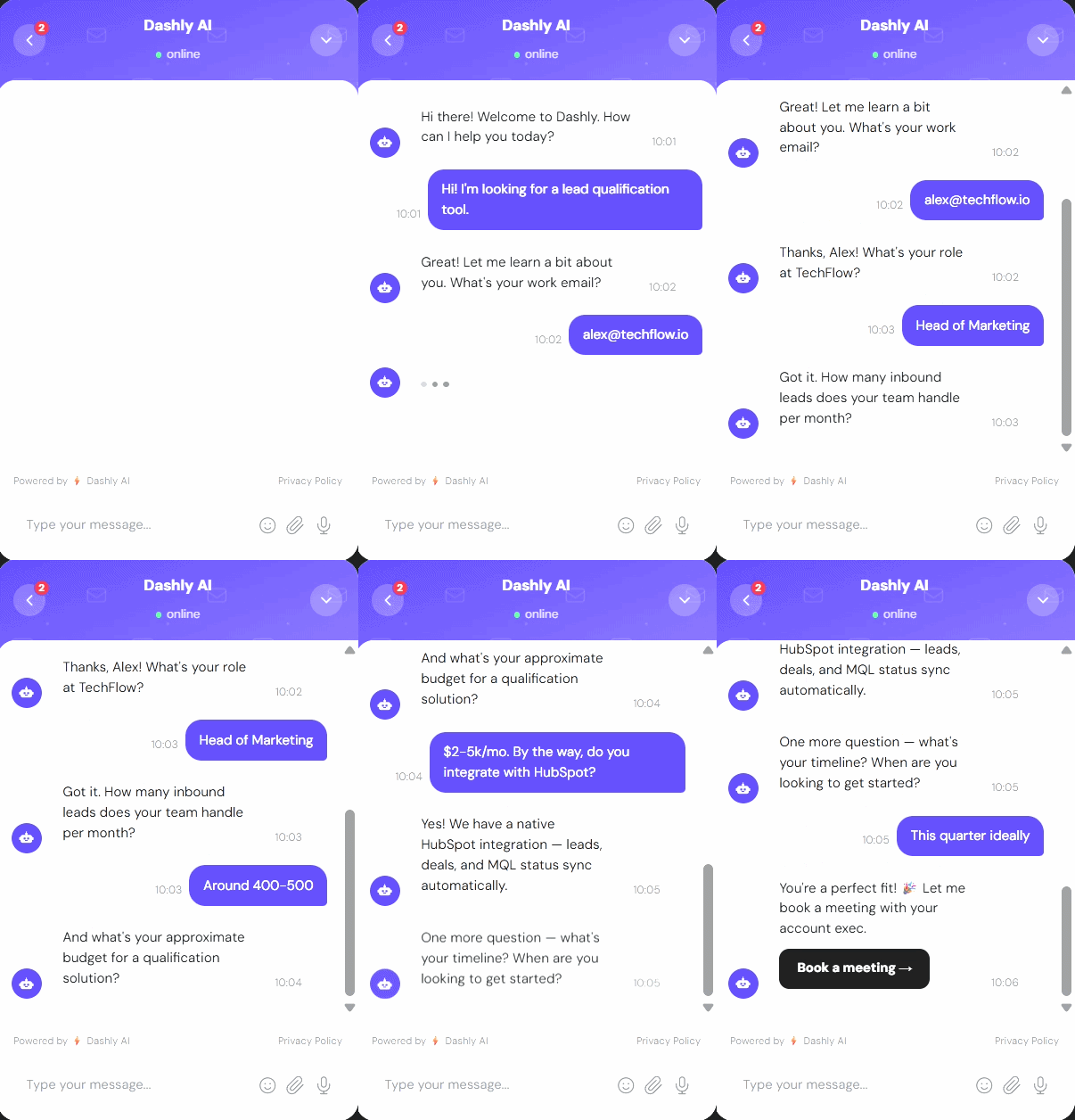
The result: the speed-to-lead problem disappears at scale. Instead of a lead sitting in a CRM queue while a rep finishes another call, the AI responds in seconds and books the meeting before the prospect’s attention shifts elsewhere.
Dashly’s AI agent converts inbound traffic into booked meetings without adding SDRs. From the first chat message to a confirmed meeting slot: under five minutes on average.
This doesn’t replace outbound for the cases where outbound makes sense: new categories, tight ICP lists, enterprise ABM. But for teams running inbound as their primary pipeline motion, AI agents remove the speed bottleneck that has historically been the biggest conversion leak.
Wrapping up
Inbound and outbound are different tools for different jobs.
Inbound earns attention over time. It builds trust, generates high-intent leads, and compounds in efficiency as your content library grows. The tradeoff is patience: three to six months before the pipeline moves consistently.
Outbound buys attention on demand. It’s faster, more targeted, and better suited for new categories or enterprise accounts where relationships matter more than content discovery. The tradeoff is cost that doesn’t scale without adding headcount.
For most B2B SaaS teams in 2026, the question isn’t which to choose. It’s what proportion to run at your current stage, and how to make the inbound side work harder with the tools now available.
The leads already coming from inbound are your highest-quality pipeline. The gap is usually in how fast you respond and how well you qualify. That’s what AI agents are built to fix.
FAQ
Inbound is when buyers find you through content, SEO, referrals, or word of mouth. Outbound is when you reach out to prospects directly through cold email, cold calls, ads, or events. The core difference is who initiates contact. In inbound, the buyer initiates. In outbound, the seller does. That difference drives a significant gap in intent, conversion rate, and cost per lead.
It depends on your stage and ICP. Inbound converts at three to five times the rate of outbound because buyers are already in research mode when they reach out. Over time, inbound produces lower CAC as content assets compound. Outbound generates faster initial pipeline and works better for new categories, narrow ICP targeting, and enterprise deals. Most mature B2B SaaS teams run a roughly 70/30 inbound-outbound mix.
Inbound examples: SEO blog posts, LinkedIn organic content, webinars, podcast appearances, community building, G2 profile optimization. Outbound examples: cold email sequences, Google Ads, LinkedIn Ads, display advertising, event sponsorships, direct mail campaigns.
Inbound lead generation attracts prospects through content and SEO. They arrive with intent already formed. Outbound lead generation means your team builds a target list and contacts people directly. Outbound leads are colder, cost more to generate, and convert at lower rates, but you can produce them on demand rather than waiting for organic traffic to build.
On average, inbound generates leads at around $135 per lead versus $346 for outbound, according to HubSpot research. That gap grows over time because content assets keep driving traffic without incremental spend. The initial investment in inbound is higher in time and production effort, but the long-term cost per lead is significantly lower.
In B2B SaaS, inbound typically means product-led growth (PLG), free trial signups, demo requests, and SEO-driven content. Outbound means SDR and BDR sequences, LinkedIn outreach, and ABM campaigns for enterprise accounts. Mature SaaS companies lean toward inbound as content compounds, while early-stage teams rely on outbound to fill the pipeline gap before inbound produces results.
SEO is inbound marketing. It attracts buyers who are already searching for a solution, so traffic comes to you rather than the other way around. Paid search (PPC) sits in a gray zone: it targets people with active search intent but uses paid placement to interrupt the experience. Most practitioners classify PPC as outbound because you are paying to push into the conversation, even if the targeting is intent-based.